MU | Century Financial Limited

Introduction
A haven asset holds its value, or gains, when other markets are falling, and gold has carried that label longer than any financial market has existed. This commodity’s reputation rests on two things that no currency shares: it has no issuer, and its role as money predates every currency in use today.
What Makes an Asset a Safe Haven?
A safe-haven asset is judged by how it behaves when confidence breaks, and calm markets reveal little about it. No asset passes every test every time, and the label describes a tendency built over many cycles. Four traits come up most:
- It keeps its value through a sell-off in equities and debt instead of falling with them.
- It stays liquid enough to trade in size when other markets are under strain.
- It carries little or no credit risk from a single issuer.
- A government or company cannot quickly expand its supply.
Why Gold Earned the Label
Gold aligns with all four safe-haven traits, which is uncommon. Other popular safe havens such as US Treasuries, the Japanese yen, and the Swiss franc each meet some of these criteria, though each relies on a government as an issuer.
A Store of Value Across Centuries
Long before paper currencies existed, gold was money, and many currencies were once convertible into it at a fixed rate. Each year’s mine output adds only a thin layer to the stock already above ground, so no producer or state can dilute it quickly.
Gold’s Relationship with Inflation and Currency Weakness
Because gold is priced in US dollars, when a currency loses purchasing power, the same ounce costs more of it; over decades, the link between gold and inflation is visible, while over single years it is loose, and gold has spent long stretches flat as consumer prices rose.
Why Central Banks Hold Gold Reserves
Central banks hold gold because it is a reserve asset that no other country controls. Any bank holding mostly dollar assets depends on US policy, while gold in its own vaults has no counterparty.
Where the Safe Haven Idea Has Limits
Gold pays no interest or dividends, and that single fact explains most periods when it disappoints as a safe haven.
Why Does Gold Fall When Real Yields Rise?
Holding gold means giving up whatever cash or bonds would have earned after inflation. Here’s an illustrative example:
- Cash deposit: USD 10,000
- Interest earned over a year: USD 450
- Purchasing power lost to inflation: USD 250
- Real return on cash: USD 450 − USD 250 = USD 200
A gold position of USD 10,000 earns USD 0, so the gold price must rise by USD 200 over the year to match cash. If interest rises to USD 650 with inflation unchanged, the real return on cash becomes USD 400, and the bar for gold doubles. Nothing about the metal changed in that example. Only the competing return did.
Why Is Gold Sold First in a Liquidity Squeeze?
When margin calls hit across portfolios, holders sell what they can at a fair price. Deep and liquid, gold goes early, and the safe-haven bid arrives only after forced selling ends.
How Volatile Is a Safe Haven?
Over decades, gold has tended to hold value, though over shorter periods it can move in wide ranges. An asset that preserves purchasing power over a generation can still swing significantly within a single year, which matters for short-term or leveraged positions.
A practical distinction is between gold as a long-term store of value and gold as a short-term trade, since each behaves differently. For those with more experience, real yields and the dollar tend to explain more of gold’s month-to-month movement than headlines about market fear.
What Moves the Gold Price
Five forces account for most of gold's movement, and on any given day they pull in different directions.
- Real Interest Rates: Higher real yields raise the return given up by holding gold
- US Dollar: A stronger dollar makes gold dearer for buyers paying in other currencies
- Central Bank Buying: Reserve purchases add demand that follows policy, not the daily price
- Risk Sentiment: Stress in equity and credit markets draws safe-haven buying
- Physical Demand: Jewelry and bar buying, with seasonal peaks around festivals in India and China
How Traders Access Gold Exposure
Gold exposure typically takes three main forms, each with a distinct relationship to the underlying metal. Futures are also available, with fixed contract sizes and expiry dates.
Physical Gold
- Bars and coins held directly
- Full ownership, no counterparty
- Storage and insurance arranged by the holder
Gold ETFs
- Exchange-listed shares backed by bullion
- Traded during exchange hours
- Ownership of the fund, not the metal
Gold CFDs
- Price exposure without ownership
- Long or short positions
- Leveraged, so losses are magnified along with gains
Gold Trading Through a Regulated Platform
Gold CFDs provide exposure to the spot price in either direction. Because leverage is used, the account's regulatory framework is relevant.
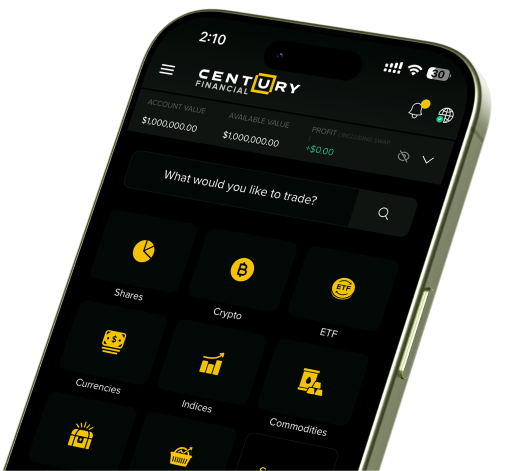
Century Financial Limited is regulated by the Financial Services Commission (FSC) Mauritius, and commodities, including gold, are covered on platforms like Century Trader and MT5.
The Golden Hedge
Gold’s reputation comes from having no issuer and from outlasting every currency built on top of it. That same history shows gold can be sold during liquidity squeezes and can underperform when real yields rise, so it tends to hedge against a loss of confidence rather than guarantee against loss.
Which side of that record shows up depends on the kind of stress in play. If you would like to talk through how gold reacts to different kinds of market stress, the Century team is glad to go through it with you.
FAQs
The content in this blog, including any research, analysis, opinions, forecasts, or other information (collectively, "Information"), is provided by Century Financial Limited (the “Company”) for marketing, educational, and general informational purposes only. It should not be construed as investment advice, a recommendation, or a solicitation to buy or sell any financial instruments.
This Information may also be published across various channels, including Company’s website, third-party platforms, newsletters, marketing materials, emails, social media, messaging apps, webinars, and other communications. While the Company strives for accuracy, we do not guarantee the completeness, reliability, or timeliness of any content. Any decisions made based on this Information are at your own risk. The Company accepts no liability for any loss or damage arising from its use.
Trading in financial products involves significant risk and may not be suitable for all investors. Please ensure you fully understand the risks and seek independent professional advice if necessary.
The Company is licensed and regulated by the Financial Services Commission (FSC) of Mauritius as an Investment Dealer (Full Service – Excluding Underwriting) under License No. GB24203860.
Please refer to the full risk disclosure mentioned on our website.