MU | Century Financial Limited

Introduction
A typical CFD risk warning notes that Contracts for Difference are complex instruments with a high risk of losing money quickly due to leverage. The main factor is that a small deposit controls a much larger position, so even a modest market move against the position can take a significant share of the account.
Reading the complex-sounding conditions in the fine print might be tedious. This article simplifies the rules every CFD trader must know, making market participation more informed and safer.
CFD Trading and Leverage
Each CFD position is margined, meaning the trader deposits a fraction of the position’s full value while the provider extends exposure to the remainder.
What is Leverage?
Leverage refers to the ratio between a position’s full market value and the margin posted to hold it. For example, at a 1:20 ratio, a USD 1,000 deposit controls a USD 20,000 position, so every point of movement is calculated on the larger figure.
Is Leverage Avoidable in CFD Trading?
A CFD carries leverage at the position level because margin is built into the product. Account-level leverage is a separate calculation. Traders usually manage this exposure by limiting position size, ensuring they have enough cushion to absorb typical market shocks.
What a CFD Risk Warning Says
Regulated providers include a CFD risk warning on their websites, marketing, and account-opening pages. The wording varies by jurisdiction, but it describes the instrument's characteristics.
The CFD risk warning typically highlights two main ideas:
- Complexity: A CFD tracks an underlying asset that the trader does not own, and the contract adds margin and close-out rules to the price.
- Speed: Leverage shortens the time between a market move and a significant loss.
Why Losses Are Common Among Retail CFD Traders
When leverage and close-out rules apply to the same account, a price move that would leave a small dent in an unleveraged holding can become a large share of equity. Below is a worked example with illustrative figures.
How Leverage Magnifies Losses
- Account equity: USD 2,000
- Position: Buy an index CFD at 20,000. USD 1 per point; notional value becomes USD 20,000.
- Margin required at 1:20: USD 1,000
- Margin call level: USD 1,000
- Stop-out level: USD 500
- Index falls 1,000 points to 19,000: equity USD 1,000; margin call
- Index falls a further 500 points to 18,500: equity USD 500; stop-out
- Realized loss: USD 1,500; three-quarters of the starting account
On an unleveraged USD 2,000 holding, the same 1,500-point move would have cost USD 150.
What Happens at a Margin Call and Stop Out
At a margin call, the provider signals that equity has reached the margin requirement, so the trader can choose to deposit funds or reduce exposure. At a stop-out, the provider automatically closes positions.
One pattern goes unstated in the CFD risk warning: the loss becomes final. Stop-outs fill at the next available price, and by definition they happen during sharp moves, so the fill often sits beyond the stop-out level itself. An index that opens on Monday below that level fills there, and the account absorbs the full gap.
Why Overtrading and Emotion Compound the Problem
Adding to a losing position increases effective leverage when equity is already reduced. Closing winners early while holding losers, sometimes called the disposition effect, tends to tilt the account toward larger losses and smaller gains.
Reading a Risk Disclosure
Each line of a standard CFD risk warning usually corresponds to a specific account event.
| Warning statement | What it means in practice |
|---|---|
| CFDs are complex instruments | Price, margin, and close-out terms act on the position at the same time |
| High risk of losing money rapidly | A move the size of the example above reaches margin call |
| Due to leverage | Gains and losses are calculated on notional value, not on the margin deposited |
| Whether the trader understands how CFDs work | Margin call and stop out levels are known before the first trade |
| Whether the trader is able to afford the high risk of losing money | The deposit is money whose loss would not affect essential finances |
Account-specific details, such as the stop-out level or whether the balance can now be zero, are found in the documents behind the warning.
How to Read a Broker’s Risk Documents
Risk material ranges from a one-line CFD risk warning to a full client agreement, with each layer adding detail that the previous one leaves out.
- Risk Warning: The headline statement on complexity and leverage
- Risk Disclosure Statement: An expanded document covering volatility, price gaps, liquidity, and counterparty risk
- Client Agreement: Margin call and stop-out levels, close-out order, and any negative balance terms
- Order Execution Policy: How orders are filled, including slippage in fast markets
Risk Controls Traders Commonly Use
Risk controls are limits set before a trade that turn a CFD risk warning into account rules, capping what one position or session can take.
What Limits Exposure Before Entry?
- Position Sizing: Each trade calculated in relation to the portfolio, so its stop loss costs a fixed fraction of equity
- Leverage Ceiling: A cap on total notional value relative to equity
- Correlation Check: Positions on related instruments, such as two US equity indices, counted as one exposure
What Controls the Exit?
- Stop Loss: An order that closes the position at a set level
- Trailing Stop: A stop that follows the price in the position’s favor and holds still when it reverses
- Time-based Exit: Positions closed ahead of weekends or scheduled data releases
What Protects the Account as a Whole?
- Margin Buffer: Equity kept well above the margin requirement, pushing the margin call further from the market
- Daily Loss Limit: A level of loss at which trading stops for the session
- Open Position Cap: A maximum number of trades running at once
A Warning Is Information
The CFD risk warning condenses the loss sequence into a single statement. Notional value determines the size of every move against the account, and the stop-out marks when that move becomes a realized loss. Each clause in the warning reflects an account term, and those terms can differ between providers.
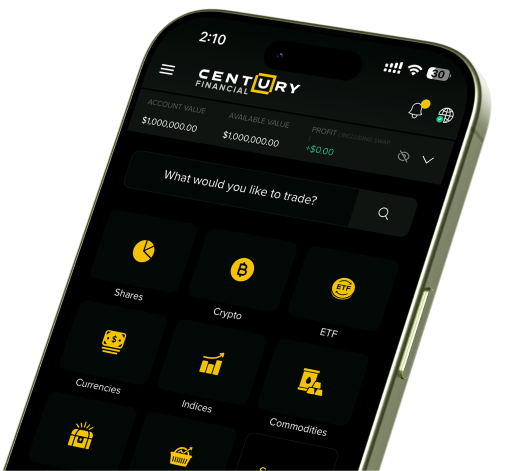
A CFD risk warning is most useful when read alongside the controls it references. Century Financial Limited is regulated by the Financial Services Commission (FSC) Mauritius, and its education-first service model treats that disclosure as the start of a conversation about leverage. On the Century Trader App and MT5, a stop loss and take profit can be attached at order entry, so the exit on a leveraged position is defined before the position is open.
FAQs
The content in this blog, including any research, analysis, opinions, forecasts, or other information (collectively, "Information"), is provided by Century Financial Limited (the “Company”) for marketing, educational, and general informational purposes only. It should not be construed as investment advice, a recommendation, or a solicitation to buy or sell any financial instruments.
This Information may also be published across various channels, including Company’s website, third-party platforms, newsletters, marketing materials, emails, social media, messaging apps, webinars, and other communications. While the Company strives for accuracy, we do not guarantee the completeness, reliability, or timeliness of any content. Any decisions made based on this Information are at your own risk. The Company accepts no liability for any loss or damage arising from its use.
Trading in financial products involves significant risk and may not be suitable for all investors. Please ensure you fully understand the risks and seek independent professional advice if necessary.
The Company is licensed and regulated by the Financial Services Commission (FSC) of Mauritius as an Investment Dealer (Full Service – Excluding Underwriting) under License No. GB24203860.
Please refer to the full risk disclosure mentioned on our website.