MU | Century Financial Limited

Introduction
Day trading involves opening and closing positions within a single trading session, with no positions carried overnight. Price moves typically unfold over minutes or hours, and the approach relies on short-timeframe charts and predefined rules for entry, exit, and position size.
This piece situates day trading among related styles and outlines how a session typically unfolds from open to close. The second half examines the risks, which tend to arise more from the number of decisions made in a day than from any single trade.
What Are Popular Types of Trading
Trading styles are often distinguished by the typical holding period. Three approaches sit on either side of day trading along this spectrum.
Scalping
Scalping focuses on capturing very small price moves, with positions held for seconds to minutes. This approach places the greatest emphasis on fast execution.
- Dozens of trades in a session
- Targets measured in a few pips or points
- Concentrated in peak liquidity
Swing Trading
Swing trading involves holding positions for several days to a few weeks, attempting to capture a segment of a wider price move. Positions remain open overnight and across weekends.
- Daily and four-hour charts
- Fewer trades, each targeting a larger price move
- Exposure to price gaps at the open
Position Trading
Position trading usually follows a trend for weeks or months, often based on economic and fundamental perspectives. Among active approaches, it operates on the longest timeframe.
- Weekly and daily charts
- Wide stops to absorb normal swings
- Driven by themes such as interest rate cycles
What Is Day Trading?
A day trade may entail buying an index CFD at the London open and selling it before the New York close. The defining feature is that traders close all positions by the end of the session, leaving the account flat overnight.
What Sets Day Trading Apart from Other Short-Term Trading Strategies
Closing all positions by the end of each session removes exposure to overnight price gaps but increases the number of decisions you must make within a narrow timeframe. An active day trader may make more trading decisions in a week than a position trader does in a year.
Scalping also closes positions within the same day, but holds for seconds and involves a higher trade frequency. Day trading sits between scalping and swing trading, with positions held long enough for an intraday move to develop.
How a Day Trading Session Typically Unfolds
In sessions that follow a fixed routine, most decisions are made before the first order is placed.
- Pre-market review: overnight developments, the economic calendar, and key price levels from the previous session
- Plan: instruments, entry conditions, stop levels and the maximum loss for the day, all set in advance
- Execution: orders placed once conditions are met, with a stop loss attached
- Monitoring: open positions managed against the plan as volatility shifts through the session
- Close and review: all positions closed by the end of the session and trades logged with reason and result
Day Trading vs. Swing Trading vs. Position Trading
| Day trading | Swing trading | Position trading | |
|---|---|---|---|
| Holding period | Minutes to hours | Days to weeks | Weeks to months |
| Overnight exposure | None | Yes, including weekends | Yes, for long stretches |
| Screen time | Hours each session | One or two check-ins a day | A few reviews a week |
| Decisions per week | Many | Several | Few |
| Main risk | Overtrading and decision fatigue | Overnight gaps | Trend reversals and long drawdowns |
No single style is inherently lower risk. A position trader faces a few large uncertainties over months, while a day trader manages many smaller ones that can add up over a week.
The Risks Involved in Day Trading
With short-duration trades, losses can accumulate through repetition, and leverage determines the scale of each instance.
How Leverage Magnifies Both Gains and Losses
Small intraday moves form the basis of each trade, so leverage is used to make these moves significant. The same leverage applies to both gains and losses. Each stop might look modest on the chart; even so, the account lost several times what the same price action would have cost without leverage.
Why Overtrading Is a Common Pitfall
Each additional trade increases exposure without necessarily providing new information. Trades placed outside planned conditions, such as during quiet hours or immediately after a loss, fall outside the intended routine. A daily loss limit typically contains this risk.
The Role of Emotion in Fast Decisions
Time pressure can reduce the interval between impulse and action. Two common outcomes are moving a stop further away to avoid a loss and closing winning trades early, both of which tend to shift results toward larger losses and smaller gains.
Markets and Tools Day Traders Commonly Use
Liquidity during the session is often the primary consideration, followed by steady intraday movement.
Markets
Major currency pairs such as EUR/USD and GBP/USD trade through the weekday clock and move furthest during the London and New York sessions. Stock indices, including the US 500 and Germany 40, draw activity at their cash opens, while gold (XAU/USD) and crude oil respond sharply to scheduled data. Large-cap shares attract day traders mainly near earnings releases.
Tools
- Charts on one-minute to one-hour timeframes
- An economic calendar for scheduled releases
- Stop-loss and take-profit orders.
- Pending orders at planned levels
- A trade journal
What Day Trading Asks of the Trader
Day trading demands sustained attention within a defined window, rules established before the session, and a tolerance for multiple small losses. Consistency tends to matter more than any individual successful trade.
For those new to day trading, the routine surrounding trades often takes the longest to develop. Entries are commonly straightforward, while elements like the daily loss limit, the journal, and the pre-market plan provide structure to each session. For experienced traders, monthly outcomes are frequently influenced more by trades placed outside planned conditions than by the quality of those within the plan. This distinction can separate stronger months from weaker ones.
Built for Fast-Moving Sessions
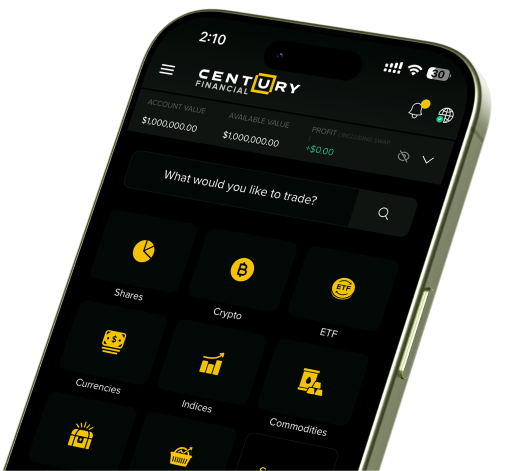
A typical day trading session relies on setting stops before a trade becomes active. On the Century Trader App and MT5, stop-loss and take-profit orders are attached at entry, and pending orders are placed at levels identified during the pre-market review.
Discipline and Speed
Day trading substitutes overnight risk with decision risk. With all positions closed by the end of the session, the most significant losses tend to result from leverage applied across multiple short trades and from decisions made under time constraints.
Whether that exchange suits a particular schedule and temperament is a personal question. Discipline and building strategies matter in this style of trading. Starting with a demo account can help you back-test your strategies before you put your money on the line.
FAQs
The content in this blog, including any research, analysis, opinions, forecasts, or other information (collectively, "Information"), is provided by Century Financial Limited (the “Company”) for marketing, educational, and general informational purposes only. It should not be construed as investment advice, a recommendation, or a solicitation to buy or sell any financial instruments.
This Information may also be published across various channels, including Company’s website, third-party platforms, newsletters, marketing materials, emails, social media, messaging apps, webinars, and other communications. While the Company strives for accuracy, we do not guarantee the completeness, reliability, or timeliness of any content. Any decisions made based on this Information are at your own risk. The Company accepts no liability for any loss or damage arising from its use.
Trading in financial products involves significant risk and may not be suitable for all investors. Please ensure you fully understand the risks and seek independent professional advice if necessary.
The Company is licensed and regulated by the Financial Services Commission (FSC) of Mauritius as an Investment Dealer (Full Service – Excluding Underwriting) under License No. GB24203860.
Please refer to the full risk disclosure mentioned on our website.