MU | Century Financial Limited

Introduction
The bid-ask spread is the gap between the price at which a market will buy an instrument from a trader and the higher price at which it will sell that instrument to a trader. Every two-sided quote carries one, and its width is set either by a provider’s fixed terms or by live liquidity in the underlying market.
This piece examines a live quote in detail and compares fixed and variable spreads. It also covers where the spread appears on a trading screen, including a location that is often overlooked.
Prices in Markets
Any market with continuous trading quotes two prices at once. One is the price at which a trader can sell right now, and the other is the price at which a trader can buy.
Bid Price
The bid is the lower of the two prices and the one a trader receives when selling—long positions close at the bid, and short positions open at the ask.
Ask Price
The ask is the higher of the two prices (also called the offer) and the price a trader pays when buying. Longs open at the ask, and shorts close there.
Bid-Ask Spread and Significance
Between those two prices sits the bid-ask spread, and every trade crosses it once on the way in and once on the way out. Its width also signals liquidity: a narrow spread means many buyers and sellers are quoting close together, and a wide one means few are.
Reading a Spread: A Worked Example
Currency spreads are counted in pips, the fourth decimal place on most pairs (JPY pairs are the exception, priced to two decimals, so a USD/JPY pip is 0.01). All figures below are illustrative.
- Quote: EUR/USD 1.08500 / 1.08508
- Bid-ask spread: 1.08508 − 1.08500 = 0.00008, or 0.8 pips
- Trade: buy one standard lot, 100,000 units, at the ask of 1.08508, where one pip = USD 10
- Value straight after the fill: marked at the bid of 1.08500, an open result of −USD 8
- Price needed to reach zero: the bid has to rise 0.8 pips, to 1.08508
- If a news release widens the spread to 3.0 pips with the midpoint unchanged, the bid drops to 1.08489, and the open result becomes −USD 19
Nothing in that last line came from the market moving against the trade. Since the midpoint never shifted, the open loss more than doubled purely because the bid-ask spread stretched around it.
Fixed vs. Variable Spreads
When a provider fixes the bid-ask spread, its width stays the same regardless of how active the underlying market is. Variable spreads follow the market instead.
What Is a Fixed Spread?
A fixed spread is a width the provider sets in its terms and holds under normal conditions. In exchange, the provider absorbs short bursts when the real market gap widens, and its protection against that exposure is the right to requote an order when prices move fast.
What Is a Variable Spread?
A variable spread, also called a floating spread, passes the market’s own gap straight through to the trader. It narrows when liquidity is deep and widens when liquidity thins; in fast markets, this shows up as slippage on the fill price.
Which Conditions Make Spreads Widen?
Whenever fewer participants are quoting, bid-ask spreads widen. That happens around the daily rollover at 5 p.m. New York time, at the Sunday reopening, and in the seconds ahead of scheduled releases such as US nonfarm payrolls or a central bank rate decision. Holiday sessions thin out quotes for most of the day.
Fixed and Variable Spreads Side by Side
Set against each other, the two models swap a known bid-ask spread for a live one, and each brings its own execution risk.
| Fixed spread | Variable spread | |
|---|---|---|
| Width set by | The provider’s terms | Live bids and offers in the market |
| Quiet, liquid hours | Holds at the set width | Narrows as more participants quote |
| Around major news | Holds, with requotes possible | Widens as participants step back |
| Main execution risk | Requote or rejected order | Slippage on the fill price |
| Known before the trade | The width itself | Only the current width |
The choice between the two models depends on which uncertainty a trader is prepared to accept in a fast market: a known width with the possibility of a refused fill, or a live width with the possibility of a less favorable one.
What Influences the Size of a Spread
Beyond timing, four features of an instrument set how wide its bid-ask spread sits on an ordinary day.
- Liquidity: heavily traded pairs such as EUR/USD quote tighter than exotics such as USD/TRY
- Volatility: wider price ranges lead liquidity providers to quote further apart
- Home market hours: an instrument quotes tightest while its main exchange or financial center is open
- Pricing model: a fixed width set by the provider, or a variable one passed through from the market
Where the Spread Shows Up on a Trading Platform
An order ticket shows the bid-ask spread as two prices side by side, sell on one side and buy on the other. Charts usually hide it because a chart built from bid prices shows only one side.
That gap matters most for stop orders. On a long position, the stop is a sell order and triggers when the bid reaches it. On a short position, the stop is a buy order and triggers on the ask, which the bid chart doesn't draw, so a widening spread can trigger a short’s stop while the chart shows price never touching the level.
For a newer trader, the most useful habit of mind is knowing which side of the quote closes each position. For an experienced trader, the widest spread a session produces sets a floor for how close a stop can sit to the market before the quote alone triggers it.
Clear Pricing, Clearly Explained
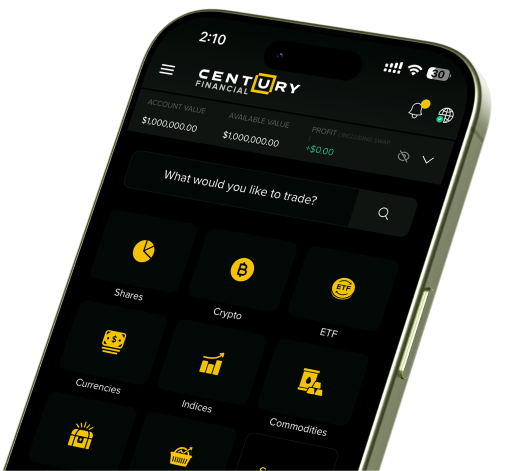
Understanding which side of the quote a stop monitors is only relevant once the stop is set before the bid-ask spread widens. Both the Century Trader App and MT5 allow a stop loss and take profit to be attached at order entry, so the trigger level on a position is established ahead of the rollover hour or a scheduled release.
A Gap Worth Understanding
Every trade begins and ends at the bid-ask spread, since positions open on one side of the quote and close on the other. Spreads often appear as small numbers until a news release or the rollover hour causes them to widen. For those interested in how spreads behave on specific instruments, a demo account that simulates real markets can help put prices into perspective.
FAQs
The content in this blog, including any research, analysis, opinions, forecasts, or other information (collectively, "Information"), is provided by Century Financial Limited (the “Company”) for marketing, educational, and general informational purposes only. It should not be construed as investment advice, a recommendation, or a solicitation to buy or sell any financial instruments.
This Information may also be published across various channels, including Company’s website, third-party platforms, newsletters, marketing materials, emails, social media, messaging apps, webinars, and other communications. While the Company strives for accuracy, we do not guarantee the completeness, reliability, or timeliness of any content. Any decisions made based on this Information are at your own risk. The Company accepts no liability for any loss or damage arising from its use.
Trading in financial products involves significant risk and may not be suitable for all investors. Please ensure you fully understand the risks and seek independent professional advice if necessary.
The Company is licensed and regulated by the Financial Services Commission (FSC) of Mauritius as an Investment Dealer (Full Service – Excluding Underwriting) under License No. GB24203860.
Please refer to the full risk disclosure mentioned on our website.