MU | Century Financial Limited

Introduction
Many accounts aren't damaged by one brilliant bad idea, but by many ordinary ones. So what is overtrading? It is trading too much, taking more trades than your plan, edge, or risk limits justify. This guide covers the signs of overtrading, why leverage makes it easier to fall into the habit, and practical steps to stop overtrading, including a daily trade limit and other rules to keep activity under control.
What Overtrading Means
Overtrading is excessive buying and selling: more activity than your strategy or risk framework supports, often driven by boredom, fear of missing out, or the urge to make back losses.
It is about frequency and quality together: you can overtrade even if each position looks small, if setups are weak, or if you're in the market mainly to feel busy. A day trader with a few planned setups is not overtrading by default; a trader who takes many half-formed entries because the screen is open probably is.
Overtrading vs Revenge Trading
The two habits overlap, but they are not identical. Revenge trading is one path into overtrading. Boredom and fear of missing out are others.
| Overtrading | Revenge trading | |
|---|---|---|
| Usual trigger | Boredom, FOMO, wins or losses | A specific loss |
| What rises | Trade count | Position size |
| Timing | Builds across a session or week | Usually immediate |
| What it breaks | Activity limits | Risk limits |
Why Traders Overtrade
Reasons usually are all psychological. But one is more technical, and we cover it in the next section.
- Quiet stretches feel uncomfortable, so traders fill the gap with low-quality entries.
- Late chase entries with wide stops and no checklist are classic overtrading signs.
- A green morning can create overconfidence, and a red trade can push you to increase trade count to recover.
- Without a narrow focus, every candle looks like a signal, which structurally leads to overtrading.
How Leverage Makes Overtrading Easier
A $6,000 account that buys $6,000 of shares has nothing left, so arithmetic, not discipline, caps how many positions you can open at once. But margin changes that since the same account can now support several positions simultaneously, and the constraint that quietly did the work before no longer applies.
There are two perspectives to consider. Neither is an argument against leverage. It does mean you have to manage position count deliberately, because the account balance no longer does it for you.
The Mental Load
With margins, each trade feels smaller than it is. Committing a few hundred in margin for a much larger position makes the decision feel proportionally lighter than the exposure it creates. The bar for taking it drops, and marginal setups start clearing a bar that was never high to begin with.
How Exposure Amplifies
Exposure stacks out of sight. Five modest positions can carry combined exposure well beyond what any one of them suggests. This is how a trader who sizes each trade carefully ends up risking something quite different overall, without ever making a decision that feels reckless.
Overtrading Signs Checklist
The list can be used as a self-check. If several items sound familiar, it may be more useful to see overtrading as a process issue rather than a willpower issue.
- You regularly exceed the number of trades in your plan.
- You enter without being able to name the setup in one sentence.
- You watch markets outside your session just in case, and then click.
- You reopen a trade moments after closing it, with no new information.
- Your average hold time shrinks while your trade count rises.
- You feel restless when flat, even when the plan says wait.
- You skip journaling because there are too many trades to log.
- You move or remove stop losses to stay in more trades.
- You could not quickly say what your total open exposure is right now.
- You cannot explain, a day later, why half your trades were taken.
How Overtrading Hurts Results
The mechanics are clear even without invented performance figures.
- More low-quality trades can dilute the edge your best setups provide.
- Leverage allows risk to stack across open positions beyond what any single one implies.
- Decision fatigue can reduce the quality of trades taken later in a session compared to earlier ones.
- A journal packed with impulse entries becomes difficult to review effectively.
That last point tends to reinforce the others. When records are difficult to learn from, overtrading can persist.
How to Stop Overtrading
Here are a few suggestions to refine your strategy and reduce the urge to overtrade.
1. Set a Daily Trade Limit
A daily trade limit sets a maximum number of new positions for each session. Set it based on how many high-quality setups typically appear. Once you reach the limit, trading activity pauses for the day.
2. Cap Open Positions, Not Just New Ones
Because leverage lets you hold multiple positions at once, a trade limit alone may not be enough. Adding a separate cap on simultaneous open positions can reintroduce the constraint that an unleveraged account would impose.
3. Define A-Grade Setups Only
A short setup checklist can filter out too much trading. If a setup does not meet all criteria, it is excluded. This approach also helps keep the trading journal more readable.
4. Pair It With a Daily Loss Limit
Trade count and loss limits can work together, with either one marking the end of a session. Some traders treat these limits as final and close the platform once reached.
5. Narrow Your Universe and Schedule Flat Time
Scheduling breaks with no trades can help reduce unnecessary activity. Focusing on fewer markets and a single primary timeframe could also support a more stable process. With fewer charts, there are fewer opportunities to overtrade.
6. Pre-Commit Size, Stops and Journal Quality
Setting risk per trade before the session begins can clarify decision-making. Recording the setup name, checklist result, and emotional state before entry for each trade can provide useful data. If many tickets lack a setup name, that may indicate a pattern of overtrading.
Illustrative Example
The figures below are made up for illustration only.
Sam has a $6,000 account. His plan allows a maximum of three trades per day, $50 risk per trade, and a $150 daily loss limit. On a quiet morning, he takes one valid setup and loses $50. Following the plan, he waits, but no second A-grade setup appears. So he stops after one trade, closing the day down $50.
If he took the overtrading path, he’d take four more marginal trades. Each requires only a small margin commitment, so none of them feels like an important decision. Two scratch, two lose $50 each. By the end of the day, he's down, plus his journal teaches him nothing.
A Simple Anti-Overtrading Rule Set
This template can be added to a trading plan, with numbers filled in as appropriate.
- Max new trades per day: ___
- Max open positions at once: ___
- Max total exposure across all positions: ___
- Risk per trade: ___
- Daily loss limit: ___
- Mandatory break after: ___ consecutive losses
- Markets allowed: ___
- No trading when: tired, after a large win, outside session, around listed news
A weekly review can help identify whether you're exceeding the trade cap. If so, it may suggest that the cap is set too high for the actual edge, or that the habit of having breaks needs further reinforcement before the cap is effective.
Where to Test a Rule Before It Matters
A rule set during a calm period remains untested until a situation forces you to confront it. A demo environment provides a low-risk space for that initial test.
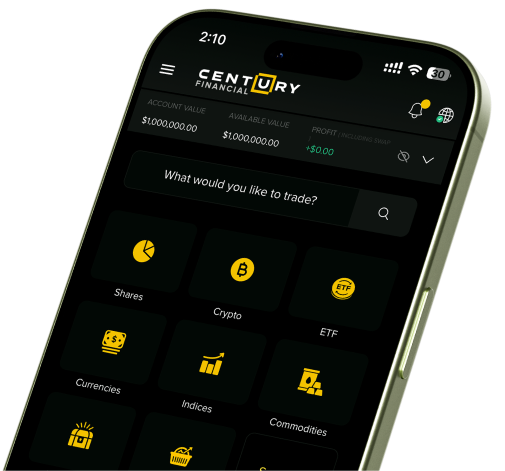
Century Financial's demo runs on the same platforms as a live account, through the Century Trader App, with the full trade history needed to count. Century Financial is regulated by the Financial Services Commission (FSC) in Mauritius, with more than 35 years of experience and an education-first approach.
Fewer Trades, Taken on Purpose
Understanding overtrading means recognizing when activity replaces process. Some causes are psychological, such as boredom or the urge to recover a loss. Others are mechanical, as leverage removes the capital constraint that once limited position count. Addressing both aspects may involve a daily trade limit, a cap on open positions, a daily loss limit, a concise setup checklist, and discipline to stay flat when no setups qualify.
Rules developed during calm periods work best when you apply them in moments of temptation. Practicing these rules in a Century Financial demo account gives you a practical measure of how often you might exceed personal limits, providing a more concrete starting point than a general resolution.
FAQs
The content in this blog, including any research, analysis, opinions, forecasts, or other information (collectively, "Information"), is provided by Century Financial Limited (the “Company”) for marketing, educational, and general informational purposes only. It should not be construed as investment advice, a recommendation, or a solicitation to buy or sell any financial instruments.
This Information may also be published across various channels, including Company’s website, third-party platforms, newsletters, marketing materials, emails, social media, messaging apps, webinars, and other communications. While the Company strives for accuracy, we do not guarantee the completeness, reliability, or timeliness of any content. Any decisions made based on this Information are at your own risk. The Company accepts no liability for any loss or damage arising from its use.
Trading in financial products involves significant risk and may not be suitable for all investors. Please ensure you fully understand the risks and seek independent professional advice if necessary.
The Company is licensed and regulated by the Financial Services Commission (FSC) of Mauritius as an Investment Dealer (Full Service – Excluding Underwriting) under License No. GB24203860.
Please refer to the full risk disclosure mentioned on our website.