MU | Century Financial Limited

Introduction
A trading plan is a written document generally setting out what you trade, when you trade, how much you risk on each position, and the conditions under which you enter and exit. It helps make decisions in advance rather than during the few seconds when a chart is moving, and judgment is at its worst.
This piece covers what belongs in a plan, how a plan differs from a strategy, a template you can fill in today, and a walkthrough of one trading day where the written rules do the deciding.
What a Trading Plan Does
A plan converts intentions into instructions. Before the session, the maximum loss for a day, instruments, and what a valid setup looks like are decided; during the session, these things are executed. The two activities stay separate, and that separation is where the most value lies. A written plan does not make a strategy profitable. It makes your behavior measurable, which is the only thing you can deliberately improve.
Trading without that separation produces an untraceable pattern of errors:
- Entering because price "looks right" rather than because a condition was met
- Widening a stop mid-trade to avoid being closed out
- Risking $30 on one setup and $300 on an identical one
- No record of which rules were followed, so no way to know what failed
Trading Plan vs Trading Strategy
A strategy says: buy a pullback to the 20-period moving average in an established uptrend. The plan answers everything the strategy leaves open. Which instruments? What percentage of equity per trade? How many positions open at once? What happens after two consecutive losses? When do you stand aside for data releases?
Losses happen despite a sound strategy because the plan was never written down and solidified. Here’s a table to see the differences at a glance.
| Trading strategy | Trading plan | |
|---|---|---|
| Covers | How you identify and take a setup | The full operating framework around those setups |
| Contents | Entry signal, indicator settings, chart conditions | Markets, sessions, risk limits, sizing, behavioral rules, review process |
| Scope | Narrow and repeatable | Broad and governing |
| Fails when | Market conditions change | Rules get rewritten under pressure |
The Six Components
Account Context and Goals
Record the account size and why the trades are being placed. Process goals outperform outcome goals here. "Follow my entry rules on at least 90% of trades this month" is measurable at month-end. "Make 5%" is not something behavior alone decides.
Instruments That Make the Cut
List the assets explicitly. A forex trading plan might permit three major pairs and nothing else. Narrow lists are easier to follow than broad ones, mostly because familiarity with how an instrument moves is itself an edge.
Sessions and Timeframes
Outline the available trading hours, and the charts and indicators as well. Most retail traders run one timeframe for entries and a higher one for context. The session you can attend consistently beats the session that looks most active.
Strategy Rules
State the required market condition, the entry trigger, the level that invalidates the idea, and the profit-taking method. If a setup takes a paragraph to describe, it might not be recognizable in real time.
Risk Limits and Position Sizing
This is the structural core of the plan. Standard components are a fixed percentage of equity risked per trade, a cap on simultaneous open positions, a daily loss limit, and a rule governing what happens after consecutive losses.
Trade Management, Filters, and Review
Decide in advance whether stops move to break-even, whether you scale out, and whether you hold through scheduled data. It’s better to write filters as rules rather than intentions. Then schedule a weekly review covering results, rule adherence, and the emotional pattern behind any broken rule.
Trading Plan Template
This is a basic buildable template for a comprehensive trading plan:
1. Profile
- Account size
- Instruments permitted
- Primary session and time zone
- Entry timeframe
- Context timeframe
2. Goals
- Process goal for the month
- Maximum daily loss
- Maximum weekly loss
3. Strategy checklist
- Setup name
- Market condition required
- Entry trigger
- Stop placement rule
- Exit or target rule.
4. Risk rules
- Risk per trade as % of equity
- Maximum open positions
- Maximum trades per day
- Daily loss limit
- Action after two consecutive losses
5. Do-not-trade list
- News windows
- Instruments or setups skipped
- Personal states: tired, rushed, immediately after a large loss or win.
6. Review
- Review day
- Metric tracked
- Minimum sample size before changing any variable.
Building the Plan in Order
Write constraints before anything else: instruments, session, risk per trade, daily loss limit.
Add strategies you have tested and understood.
Define stop placement and exit method so every position has a predetermined exit.
Add behavioral rules, including the consecutive-loss clause.
Run the complete plan, not just the entry signal, across a set number of trades.
Review, then change one variable at a time once you have enough trades to judge.
Where Plans Break
- Adopting someone else's plan without the account size or schedule it was built for
- Running four overlapping setups, which makes attribution impossible
- Rewriting rules mid-drawdown rather than at the scheduled review
- Tracking profit and loss while tracking rule adherence not at all
Putting the Plan into the Platform
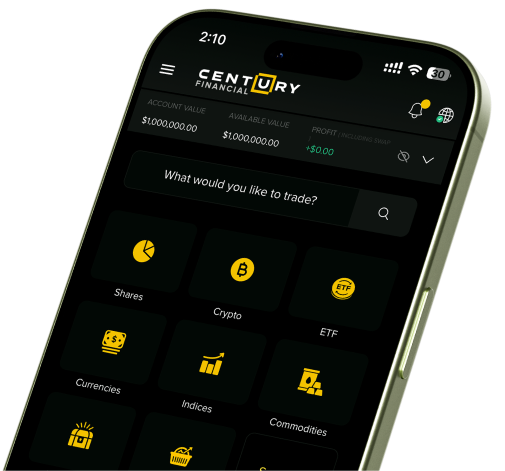
Century's education-first model, intutive platforms, and demo account options gives you a chance to learn, test, and execute strategies without committing real capital. Stop-loss orders and other options to customize the platform allows you to setup things way in advance.
Rules Decided Before the Session
A trading plan is specific by definition: named instruments, named hours, a fixed percentage at risk, a stated invalidation level, and a review schedule. The components are not complicated. They work because you write them down when nothing is at stake, and keep them fixed when something is.
Century Financial Limited has spent more than 35 years working with traders at exactly this point, where the framework is understood but not yet habitual. Regulated by the Financial Services Commission in Mauritius, and offering access to shares, indices, currencies, commodities, ETFs, and treasuries through MT5 and Century Trader, the setup is built to execute your rules rather than require you to remember them.
FAQs
The content in this blog, including any research, analysis, opinions, forecasts, or other information (collectively, "Information"), is provided by Century Financial Limited (the “Company”) for marketing, educational, and general informational purposes only. It should not be construed as investment advice, a recommendation, or a solicitation to buy or sell any financial instruments.
This Information may also be published across various channels, including Company’s website, third-party platforms, newsletters, marketing materials, emails, social media, messaging apps, webinars, and other communications. While the Company strives for accuracy, we do not guarantee the completeness, reliability, or timeliness of any content. Any decisions made based on this Information are at your own risk. The Company accepts no liability for any loss or damage arising from its use.
Trading in financial products involves significant risk and may not be suitable for all investors. Please ensure you fully understand the risks and seek independent professional advice if necessary.
The Company is licensed and regulated by the Financial Services Commission (FSC) of Mauritius as an Investment Dealer (Full Service – Excluding Underwriting) under License No. GB24203860.
Please refer to the full risk disclosure mentioned on our website.