MU | Century Financial Limited

Introduction
People often use market volatility as a synonym for danger, which is convenient but not quite accurate. Volatility measures how much prices move. Whether that movement amounts to risk depends on factors the measurement itself knows nothing about, and that gap is where most of the confusion lives.
A Measurement, Not a Verdict
Risk and volatility are separate concepts. In most practical definitions, risk is the chance of permanent loss or of missing an objective. Volatility is movement, and movement can be temporary. Under specific conditions, one can convert into the other, but they are not interchangeable.
How It Actually Gets Measured
The word covers several calculations, and each answers a different question.
| Measure | What it uses | Direction of view |
|---|---|---|
| Standard deviation | Dispersion of past returns | Backward |
| Average true range | Average price range per period, in price units | Backward |
| Implied volatility | Option prices for a future window | Forward |
| VIX | Implied volatility on S&P 500 options, next 30 days | Forward |
Backward-looking measures describe what already happened. Forward-looking measures describe what the options market is currently charging for future uncertainty. The two frequently don’t match, and that gap is itself watched.
What the Number Cannot See
Standard deviation treats a 5% gain and a 5% loss identically. Both move away from the average, and the formula doesn't care which direction. This is why a share jumping 20% on strong earnings registers as volatile in the same way as one falling 20% on weak results. Describing a market as volatile says nothing about whether it has been rising or falling.
Practitioners noticed the problem. Downside deviation and the Sortino ratio exist specifically to measure the part other ratios mix, which is a fairly direct admission that the standard measure is blind to something that matters.
When Volatility Turns into Risk
Three things convert price movement into realized loss, and none of them is the volatility itself.
- Leverage: An unleveraged position can sit through a 20% drawdown. A leveraged one may close automatically before any recovery arrives, turning a temporary move into a permanent outcome.
- Holding Period: A drawdown is only temporary if nothing compels you to sell during it. A fixed deadline removes that option.
- Position Size: The same 20% swing is trivial at 2% of capital and consequential at 40%. The market did the identical thing in both cases.
Why Quiet Markets Are Not Safe Markets
An extended trend with predictability is seldom the peaceful idea of markets. Extended calm tends to encourage larger positions and more leverage, because recent experience suggests less is at stake. Exposure is therefore often at its largest when conditions change.
The Same Word, Very Different Numbers
Volatility is not one figure across a portfolio. A major currency pair, a broad index, gold, and a single share move at genuinely different magnitudes, which means position-sizing habits built on one rarely transfer cleanly to another.
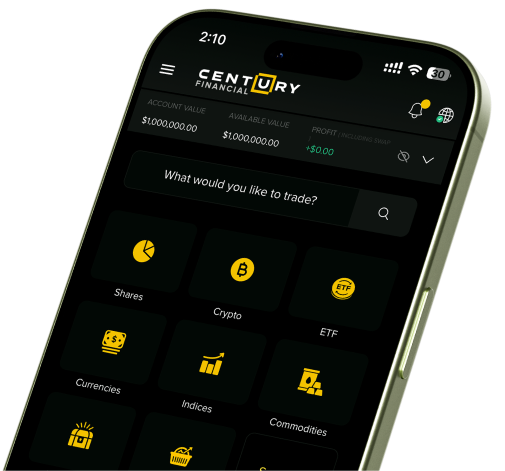
That becomes visible when the instruments sit side by side. Century Financial offers shares, indices, currencies, commodities, ETFs, and treasuries in a single account through the Century Trader App and MT5, with the range and indicator tools to compare how differently each behaves—regulated by the Financial Services Commission (FSC) in Mauritius.
The Measure and the Meaning
Volatility is one of the few market concepts that could be precisely defined and routinely misused. It does not separate gains from losses; it indicates no direction, and on its own it says nothing about whether a position is dangerous. Leverage, holding period, and size determine that, and they sit with the person holding the position rather than with the market.
That is the part worth caring about because all three are decisions rather than forecasts. Century Financial offers the instruments and the tools to see how differently each market actually behaves, along with a demo environment for anyone who wants to watch a few of them move before any capital is involved.
FAQs
Disclaimer: CFDs are complex instruments and come with a high risk of losing money rapidly due to leverage. 74–89% of retail investor accounts lose money when trading CFDs. You should consider whether you understand how CFDs work and whether you can afford to take the high risk of losing your money. Past performance is not indicative of future results. This content is for informational purposes only and does not constitute investment advice or a recommendation to buy, sell, or hold any financial instrument. Century Financial does not guarantee the accuracy, completeness, or timeliness of this information and accepts no liability for any loss arising from its use.