MU | Century Financial Limited

Introduction
Despite its perceived complexities, trading can become easy to understand for people willing to learn. This How to Trade series, in four weekly parts—Week 1, Week 2, Week 3, and Week 4—covers ideas and aspects for anyone who wants to become a trader.
Week one covers the trading basics everything else rests on: what the two prices quoted on every instrument actually mean, what makes a price change, what you are really holding among different instruments, and how to configure a screen you can learn from.
No trades get placed this week. Position sizing, chart reading, and everything after them depend on the material here.
What a Price Actually Is
At any moment, buyers are willing to pay up to a certain level, and sellers are willing to accept down to a certain level. The highest buying price is the bid, the lowest selling price is the ask, and every instrument quotes both continuously. The last traded price simply records where the two most recently met.
Beginners often describe what "the market thinks," as though it were a single entity holding a view. It isn't. It is the running total of disagreements, and the price marks where that disagreement currently sits.
Why Prices Move
Prices do not move because of news. They move because somebody acted on news. A figure is released. It changes what participants are willing to pay or accept. Price starts changing when a buyer agrees to a higher ask or a seller accepts a lower bid, and those completed transactions are what a chart records.
This explains a pattern that confuses newer traders constantly: a market moving opposite to what an announcement seemed to imply.
Why Does Good News Sometimes Push a Price Down?
Price can only move if participants are left who haven't already acted on the news. Grasping this makes week three considerably easier, because a candle stops being a shape and becomes a record of who was willing to act, and where. Some reasons for prices moving against the assumption include:
- Expectation is already reflected in the price
- Guidance is weaker than the headline figure
- Buyers were positioned ahead of the release
- Holders are taking profit on the move itself
What You Are Actually Trading
| Instrument | What you hold | What tends to move it |
|---|---|---|
| Shares | Part ownership of a company | Company results, sector conditions |
| Indices | Exposure to a basket of shares | Broad sentiment, rates, earnings season |
| Currency pairs | The relative value of two currencies | Rate expectations, economic data |
| Commodities | Exposure to a physical good | Supply, demand, dollar strength |
| CFDs | A contract on price, no ownership | The underlying instrument's price |
Placing the Trade
A market order accepts the best available price. A limit order trades only at your specified level or better, and accepts that it may never execute. A stop order stays dormant until a level is traded, then becomes a market order.
Each prioritizes something different. Market orders prioritize execution certainty, limit orders prioritize price, and stop orders prioritize reacting to something that hasn't happened yet. Choosing between them is a decision about which of those three matters most for a given intention.
Setting Up a Screen You Can Learn On
Configuration done once in week one might only need minor adjustments thereafter, and a cluttered screen makes every later lesson harder. Instructions below can be considered for setting things up:
- Check which time zone your platform's charts run on, since it rarely matches local time and every candle boundary depends on it
- Start with one timeframe and a clean chart, adding indicators only when you can explain what each one measures
- Keep the watchlist to the essentials, chosen so their active hours overlap with when you are actually available
- Set price alerts rather than watching continuously, and save the configuration as a template
Activity isn't evenly distributed throughout the trading day either. It concentrates around session opens, scheduled releases, and the overlap between major financial centers, which is worth knowing before wondering why an instrument sat still for three hours.
This Week's Output
Week one lays the foundation for the future lessons. You can explain what bid and ask represent; you can say what drives each instrument on your shortlist and why those drivers differ. And you have a configured screen with a short watchlist rather than a wall of charts.
Watching the Differences Directly
The mechanism registers faster through observation than through reading. A currency pair, an index, and a single share on one screen make the contrast obvious within an hour: how often each updates, how each responds to the same scheduled announcement, how differently they behave outside their busiest window.
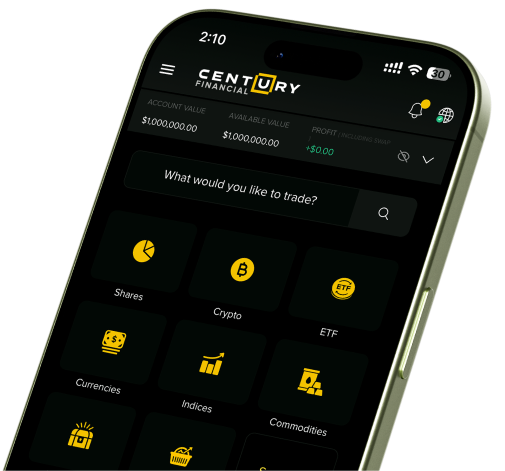
Century Financial offers shares, indices, currencies, commodities, ETFs, and treasuries through the Century Trader and MT5, putting that comparison in one place during a week meant for watching rather than acting. Century Financial is regulated by the Financial Services Commission (FSC) in Mauritius, with more than 35 years and an education-first approach behind it.
Mechanism Before Meaning
Nearly every question that arrives later depends on this week. Why a chart gapped overnight, why a level broke and immediately reversed, why strong news moved a price the wrong way. All of them are mechanism questions dressed as strategy questions, and learning the mechanism first turns them from surprises into things you can reason through.
Week two moves to position sizing, deliberately ahead of any chart work, because you have to settle what a wrong answer costs before you can judge any method. It will make more sense after having spent a week understanding what actually happens when a price changes.
FAQs
The content in this blog, including any research, analysis, opinions, forecasts, or other information (collectively, "Information"), is provided by Century Financial Limited (the “Company”) for marketing, educational, and general informational purposes only. It should not be construed as investment advice, a recommendation, or a solicitation to buy or sell any financial instruments.
This Information may also be published across various channels, including Company’s website, third-party platforms, newsletters, marketing materials, emails, social media, messaging apps, webinars, and other communications. While the Company strives for accuracy, we do not guarantee the completeness, reliability, or timeliness of any content. Any decisions made based on this Information are at your own risk. The Company accepts no liability for any loss or damage arising from its use.
Trading in financial products involves significant risk and may not be suitable for all investors. Please ensure you fully understand the risks and seek independent professional advice if necessary.
The Company is licensed and regulated by the Financial Services Commission (FSC) of Mauritius as an Investment Dealer (Full Service – Excluding Underwriting) under License No. GB24203860.
Please refer to the full risk disclosure mentioned on our website.