MU | Century Financial Limited

Introduction
The AI bubble question comes down to a detail most coverage skips: how much of the announced money has actually changed hands. Between 2025 and 2026, a small group of technology companies pledged sums large enough to move global indices. Some of that capital is funded. Some is conditional. Knowing which is which changes what the figures mean.
Where the Money Goes
Capital in the AI buildout tends to travel in circles. An investor funds a lab, the lab spends much of that funding on the investor's own chips or cloud capacity, and the investor books revenue.
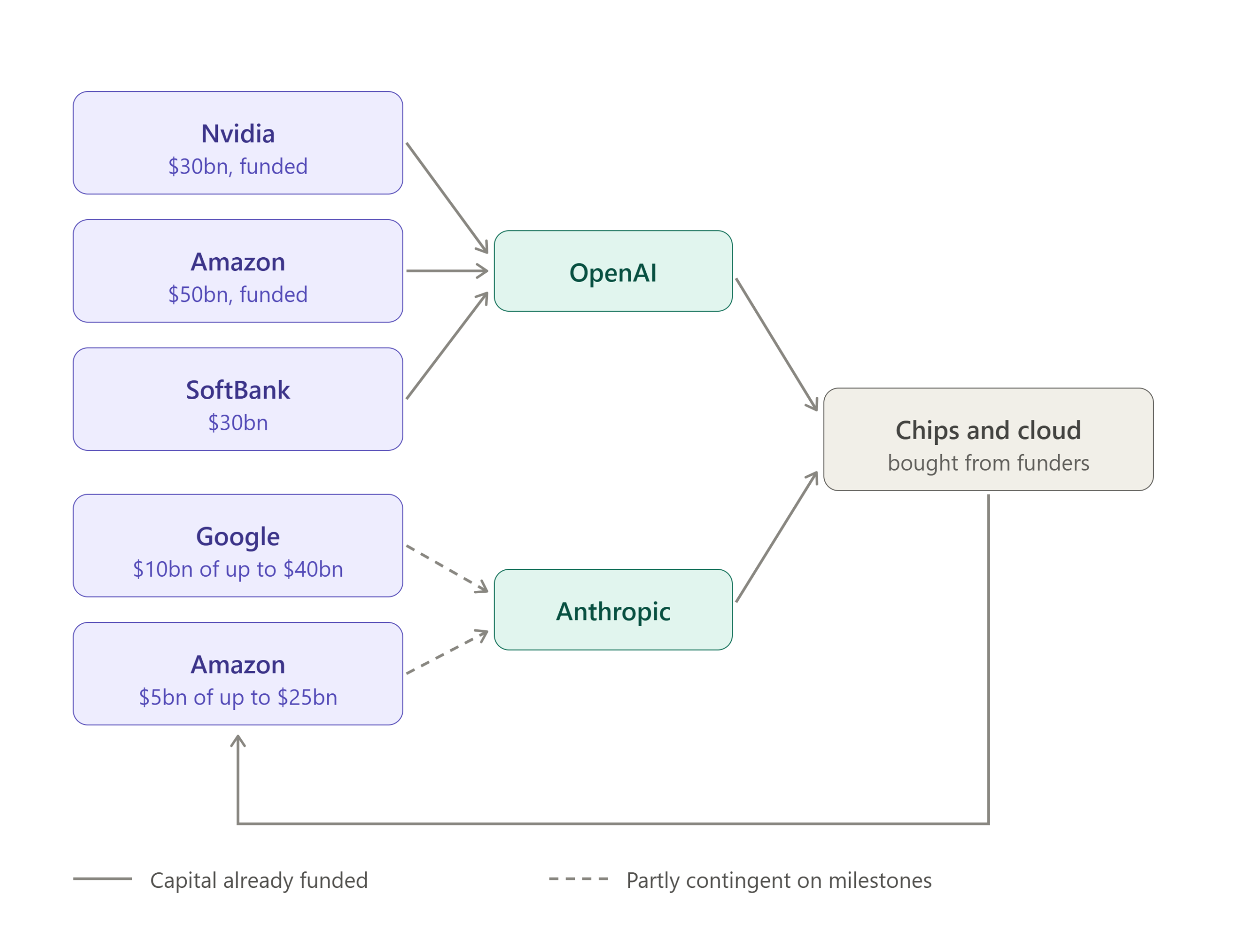
Who Funds Whom?
| Funder | Recipient | Amount | Status | Date |
|---|---|---|---|---|
| Nvidia | OpenAI | $30B equity | Funded | February, 2026 |
| Amazon | OpenAI | $50B, ~5% stake | Completed | July, 2026 |
| SoftBank | OpenAI | $30B follow-on | Funded | 2nd tranche July, 2026 |
| Anthropic | $10B now, up to $40B | Partly contingent | $10B given April, 2026 | |
| Amazon | Anthropic | $5B now, up to $25B | Partly contingent | April, 2026 |
Why the Same Money Appears Twice
Circular financing describes capital acting as both an equity stake and a vendor payment. The structure makes reported revenue harder to separate from subsidy, which is one reason the same deal supports opposite conclusions.
Announced vs Committed
Several of the largest figures in the AI bubble debate are ceilings rather than cheques. They are released in stages, against milestones, and sometimes they are revised downward.
The Nvidia Example
In September 2025, Nvidia and OpenAI announced a letter of intent for up to $100 billion, released progressively as each gigawatt of systems was deployed. By early 2026, that had become a $30 billion equity stake, after Nvidia's CFO confirmed the figure sat outside the company's disclosed bookings guidance. Roughly $70 billion in intended exposure did not proceed.
How Much Is Conditional?
Google's commitment to Anthropic is $10 billion in cash, with $30 billion tied to performance targets. Amazon's $50 billion investment in OpenAI began at $15 billion, with $35 billion contingent on a trigger, and was completed a few months later.
Two Ways to Read It
The same tranche structures support opposite conclusions, which is where the disagreement over the AI bubble genuinely sits.
- Read one way, staged funding shows investors managing risk rather than deploying unconditionally
- Read the other way, it shows the parties with the best information declining to commit everything up front
- Both readings come from identical filings, and neither requires the other side to be arguing in bad faith
If the Bubble Deflates, and If It Doesn't
| If It Deflates | If the Sceptics Are Wrong | |
|---|---|---|
| Index concentration | Falls as leaders derate | Persists, possibly widens |
| Capex cycle | Contingent tranches lapse | Tranches convert, spending extends |
| Credit exposure | Primarily equity, so losses sit with shareholders | Debt financing likely increases |
| Volatility | Elevated across correlated names | Elevated on each earnings cycle |
| Sector rotation | Toward value and defensives | Broadens into AI-adjacent sectors |
| Timeline | Repricing can be rapid | Multi-year and uneven |
What's Measurable Today
Concentration is the exposure both columns share. A portfolio weighted toward a small group of correlated names depends on a single outcome whichever column proves accurate. Concentration can be measured now, but not the direction of the cycle.
No One Is Selling Certainty
The AI bubble argument will not be settled by any single quarter of disclosures. What the filings do show is a mix: capital that has moved, capital waiting on milestones, and capital quietly withdrawn. Following the structure of these commitments tells you more than the size of the headlines attached to them.
Markets rarely wait for arguments to be resolved, which is why the breadth of access tends to matter more than any single view being correct. Century Financial brings over 35 years of market experience and FSC Mauritius regulation to traders worldwide, with the Century Trader App putting shares, indices, commodities, unlisted securities and more within reach from anywhere. If you are reviewing how your exposure is spread, it is a good time to consider what else is available to you.
FAQs
Disclaimer: CFDs are complex instruments and come with a high risk of losing money rapidly due to leverage. 74–89% of retail investor accounts lose money when trading CFDs. You should consider whether you understand how CFDs work and whether you can afford to take the high risk of losing your money. Past performance is not indicative of future results. This content is for informational purposes only and does not constitute investment advice or a recommendation to buy, sell, or hold any financial instrument. Century Financial does not guarantee the accuracy, completeness, or timeliness of this information and accepts no liability for any loss arising from its use.