Introduction
A single headline can change the mood of a trading screen within minutes. For anyone exposed to local equities, the rupee, commodities, or global CFDs, understanding the geopolitical risks Pakistani traders encounter is basic market literacy, not a niche concern.
This article answers a simple question: how do regional and global events filter into a Pakistani portfolio? Tension on a distant border, a sanctions announcement, or a political transition can shift investor confidence, move oil, change currency expectations, and alter the cost of borrowing abroad. Each of these then reaches different holdings in different ways.
How Geopolitical Events Reach Pakistani Markets
Geopolitical news doesn't hit a portfolio directly and often overlaps. An oil shock, for instance, hits sentiment, the import bill, the currency, and inflation expectations at once. It travels through channels, and knowing them helps you judge which of your positions are actually exposed.
- Investor outlook
- Capital flows
- Currency
- Commodity prices
- Remittances
- External financing
Types of Geopolitical Events Pakistani Traders Should Watch
- Regional security developments
- Relations with neighbors
- Global disputes and sanctions
- IMF and bilateral financing news
- Domestic political transitions
- Gulf developments affecting remittances
Worked Example: A Headline Shock and a Hypothetical Portfolio
Take, for example, a trader holding three things: a basket of PSX shares, a USD/PKR position, and some gold exposure. All reactions below are hypothetical and non-numeric.
The headline: A conflict far from Pakistan disrupts a major energy-shipping route.
- Equities: Sentiment weakens first. Energy-importing sectors suffer most, while some energy producers may hold up better. The share basket is likely to become more volatile.
- USD/PKR: Concerns about the import bill and reserves add upward pressure on the dollar. The trader's position may gain or lose depending on its direction, and quotes may move erratically.
- Gold: Safe-haven demand may lift the dollar price, and a softer rupee could add to the local-currency gain. If the dollar strengthens broadly, though, gold's rise could be muted.
The portfolio's equity and currency exposures may react similarly, so the trader is less diversified than the holdings suggest. A trader who sized positions in advance and set exit levels can respond calmly. One who did neither may be forced to decide under pressure.
Managing Geopolitical Risk in Your Portfolio
Risk management cannot remove uncertainty, but it limits how much any single event can damage your account.
- Diversify across assets and drivers: Hold exposures that don't all depend on the same channel, such as local equities, metals, and different currency pairs.
- Size positions sensibly: Risk only a small share of capital on any one trade so a gap move does not cause serious damage.
- Use stop-loss trades: Predefined exits help limit losses, though in fast markets execution may occur at a worse price than planned.
- Be cautious with leverage: Forex and CFD leverage magnifies both gains and losses, and headline-driven volatility can trigger margin calls quickly.
- Avoid reactive trading: Entering or exiting immediately after a headline often means trading on limited information.
- Plan scenarios: Write down what you would do if tension escalates, stays the same, or fades, before it happens.
- Use an economic calendar: Scheduled events such as central bank meetings, financing reviews, and elections let you reduce exposure or prepare in advance.
No strategy guarantees an outcome. Markets can move against any plan, and losses are possible, particularly with leveraged products.
A Practical Checklist for Monitoring Headlines
A routine keeps you from reacting to every alert. Use these points as a filter:
- Check source quality
- Confirm across sources
- Separate noise from signal
- Note the timing
- Watch volatility around events
- Review your exposure
Following Global Markets on Century Financial's Trading Platform
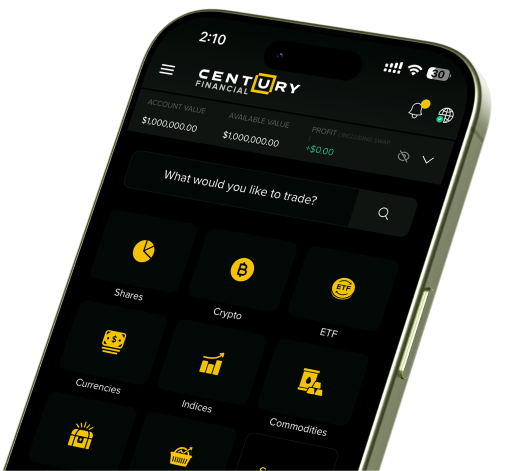
Once you have a framework for reading headlines, you need tools to follow how markets respond. Century Financial's trading platform offers access to a range of instruments across forex, metals, energy and indices, so you can observe how different asset classes react to the same event in one place.
Mobile access lets you check positions and prices when news breaks away from your desk. Charting tools help you review how an asset behaved around earlier events, and price alerts can notify you when a level is reached, decreasing the need to watch screens constantly. These features support research and discipline. They do not remove market risk, and trading leveraged products can result in losses.
Staying Prepared on Geopolitical Risk
Geopolitical risk reaches Pakistani traders' portfolios through sentiment, capital flows, the rupee, energy prices, remittances, and external financing. Equities tend to be most exposed to mood, the rupee to import and dollar demand, and gold may attract interest but offers no guarantee.
Preparation beats prediction. Diversified holdings, sensible position sizes, defined exits, and a practice of reviewing reliable sources give you room to think when headlines turn loud. To practice this approach, explore how different markets move and review your risk plan before the next major event.
FAQs
The content in this blog, including any research, analysis, opinions, forecasts, or other information (collectively, "Information"), is provided by Century Financial Limited (the “Company”) for marketing, educational, and general informational purposes only. It should not be construed as investment advice, a recommendation, or a solicitation to buy or sell any financial instruments.
This Information may also be published across various channels, including Company’s website, third-party platforms, newsletters, marketing materials, emails, social media, messaging apps, webinars, and other communications. While the Company strives for accuracy, we do not guarantee the completeness, reliability, or timeliness of any content. Any decisions made based on this Information are at your own risk. The Company accepts no liability for any loss or damage arising from its use.
Trading in financial products involves significant risk and may not be suitable for all investors. Please ensure you fully understand the risks and seek independent professional advice if necessary.
The Company is licensed and regulated by the Financial Services Commission (FSC) of Mauritius as an Investment Dealer (Full Service – Excluding Underwriting) under License No. GB24203860.
Please refer to the full risk disclosure mentioned on our website.