MU | Century Financial Limited

Introduction
Leverage lets you open a bigger position than your margin deposit alone allows, and it comes with rules. So what is a margin call? It is a warning from your broker that your account equity has fallen too low to support your open leveraged positions. This guide explains margin calls in forex and CFDs, how margin level and free margin are calculated, the difference between a margin call and a stop out, and practical ways to avoid one.
What a Margin Call Actually Is
When you trade CFDs or forex on margin, part of your account is set aside as collateral for each open position. If market losses pull your equity below the level required to maintain those positions, the broker asks you to add funds. That request is the margin call.
It is not a fee, and it is not a penalty. It tells you your positions have moved close to the point where the platform will start closing them for you.
The Four Numbers on Your Screen
MT5 and most other platforms display four figures. They are easy to confuse, and only one of them actually drives a margin call.
| Term | What it means |
|---|---|
| Balance | Account cash, excluding running profit or loss on open trades |
| Equity | Balance plus or minus the unrealized profit or loss on open trades |
| Used margin | Total margin locked to support your open positions |
| Free margin | Equity minus used margin, available for new trades or to absorb losses |
Equity is the one to watch. Balance stays the same while trades are open, so an account can show a comfortable balance even when equity has fallen far enough to trigger a warning. Used margin, meanwhile, barely moves.
How Margin Level Is Calculated
Brokers trigger margin calls and stop-outs using margin level, expressed as a percentage:
Margin level (%) = (Equity ÷ Used margin) × 100
At 100%, equity exactly equals the margin your positions require, and free margin is zero. Below that, your equity no longer fully covers what the positions need.
Margin Call vs Stop Out
People constantly search for these two together, and the distinction is simple once you see them side by side.
| Margin call | Stop out | |
|---|---|---|
| What it is | A warning | An automatic action |
| What happens to positions | Usually stay open | Closed by the platform |
| What you can still do | Deposit, close trades, or wait | Nothing, it has already happened |
| Typical restriction | No new positions until level recovers | Positions closed until level recovers |
Thresholds vary by broker and by jurisdiction. Under ESMA's 2018 product intervention measures, firms offering CFDs to retail clients in the EU must apply a margin close-out rule at 50% of the minimum required margin, calculated per account. Other regimes set their own levels, and some brokers run a warning threshold well above the close-out point while others trigger both at once.
Stop-outs generally close the largest losing position first and work down until margin level recovers. One qualification matters here: the close happens at the next available market price. In a fast market, or across a weekend gap, the fill can land worse than the stop-out level implies.
A Worked Example
Teaching example only. The thresholds below are hypothetical, not a forecast or a promised outcome.
Assume a broker sets the margin call at 100% and the stop-out at 50%. You deposit $1,000 and open a $10,000 CFD position with a 5% margin requirement (1:20 leverage). The used margin is $500.
| Stage | Equity | Used margin | Margin level | What happens |
|---|---|---|---|---|
| Position opened | $1,000 | $500 | 200% | Normal, free margin is $500 |
| Market moves against you, -$300 | $700 | $500 | 140% | Above both thresholds |
| Loss reaches -$500 | $500 | $500 | 100% | Margin call, free margin is zero |
| Loss reaches -$750 | $250 | $500 | 50% | Stop out, position closed |
Now look at what those losses represent in the underlying market. A $500 loss on a $10,000 position is a 5% adverse move. The $750 that forced the close-out is 7.5%.
So at 1:20, modest by CFD standards, a 5% move was enough to exhaust the entire buffer, as leverage magnifies both directions, which is why small moves can have large effects on the account.
Why Margin Calls Happen
- Open losses reduce equity directly, and equity is the numerator in the margin level calculation.
- Several positions at once leave little free margin to absorb anything.
- Brokers can increase the margin they require on an instrument.
- Weekend gaps and news-driven moves can shift equity faster than anyone can react.
How to Avoid a Margin Call
Leveraged trading cannot be made risk-free. These habits could help reduce how often you have to ask.
- Size from risk, not from available leverage
- Use stop orders
- Watch margin level, not balance
- Keep a buffer well above the call threshold
- Limit correlated positions
- Plan around news and weekends
- Know your own thresholds
Finding Your Own Numbers
Every threshold discussed here is account-specific, and all of them are published rather than hidden.
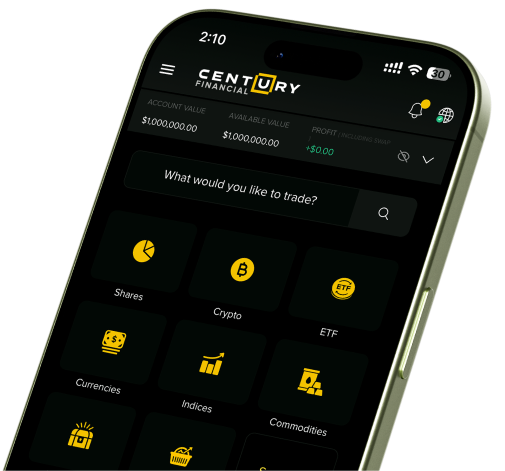
Century Financial sets out margin call and stop-out levels in its account documentation, alongside the margin requirement for each instrument. Both the Century Trader and MT5 display balance, equity, used margin, free margin,, and margin level live while positions are open, making their relationship visible rather than theoretical.
One Warns, The Other Acts
A margin call and a stop out are two points on the same descending line. The first asks you to do something. The second removes the choice. Between them sits a window that can be very short, because the worked example above went from a comfortable 200% margin level to a forced close on a 7.5% market move, at leverage that most traders would consider conservative.
Track equity rather than balance, find your account's two thresholds before a position is open, and size so that ordinary volatility does not walk you toward either one. A demo account on the Century Trader App or MT5 shows all five numbers updating in real time, which is a cheaper way to learn how quickly they move than finding out on a live position.
FAQs
The content in this blog, including any research, analysis, opinions, forecasts, or other information (collectively, "Information"), is provided by Century Financial Limited (the “Company”) for marketing, educational, and general informational purposes only. It should not be construed as investment advice, a recommendation, or a solicitation to buy or sell any financial instruments.
This Information may also be published across various channels, including Company’s website, third-party platforms, newsletters, marketing materials, emails, social media, messaging apps, webinars, and other communications. While the Company strives for accuracy, we do not guarantee the completeness, reliability, or timeliness of any content. Any decisions made based on this Information are at your own risk. The Company accepts no liability for any loss or damage arising from its use.
Trading in financial products involves significant risk and may not be suitable for all investors. Please ensure you fully understand the risks and seek independent professional advice if necessary.
The Company is licensed and regulated by the Financial Services Commission (FSC) of Mauritius as an Investment Dealer (Full Service – Excluding Underwriting) under License No. GB24203860.
Please refer to the full risk disclosure mentioned on our website.