MU | Century Financial Limited

Introduction
Ask ten people to explain investing vs trading, and most will answer with a calendar—investors hold for years; traders hold for days. That answer is accurate and unhelpful. The differences that matter sit underneath it, and four widely repeated myths keep them buried.
Start With the Overlap
Both approaches begin identically. Capital goes into an asset because you expect its price to appreciate with an understanding of the risks involved. Both require choosing what to buy, deciding how much, and knowing what would make you stop.
Neither is a serious version of the other. That shared ground is worth establishing first, because the real differences are narrower than the usual framing suggests.
Myth 1: The Difference Is Time
What genuinely separates the two is where the return comes from.
An investor’s return depends on the asset doing something: a company growing earnings, paying dividends, compounding retained profit. That takes years because business results take years to arrive. A trader’s return comes from price movement alone. Prices move constantly, so the timeframe compresses.
Myth 2: Trading Is Riskier Than Investing
Risk in both cases comes from three things: how much leverage is applied, how large a position is relative to the account, and how concentrated the holdings are. None of those belongs exclusively to trading.
A concentrated single-stock holding can lose most of its value without its owner ever placing a second order. An unleveraged position in a broad index, held for a week, is a considerably smaller bet. Timeframe is not the variable doing the work in either case.
Myth 3: Investing Is Passive
Buying and holding still requires choosing what to buy, deciding what weight it gets, recognizing when a thesis has broken, and rebalancing as price drift pulls an allocation away from its target.
The decisions are less frequent, not absent. Someone who never revisits a position has not chosen patience but passivity. They have chosen not to decide, which carries its own costs.
Myth 4: You Have to Pick One
Most people already run both and do not label it that way. A long-term holding compounding quietly while a separate position is taken on a six-week view is two approaches.
The institutional version has a name: core and satellite, where a long-term core holds most of the capital and smaller tactical positions sit around it. The two coexist because they answer different questions with different money.
What Actually Differs
With the myths cleared, the genuine distinctions are easier to state.
| Investing | Trading | |
|---|---|---|
| Source of return | Asset performance | Price movement |
| Typical instruments | Shares, ETFs, bonds | CFDs, futures, spot FX |
| Direction | Long, in practice | Long or short |
| Cost of holding | Minimal | Financing on leveraged positions |
| Decision frequency | Low | High |
| What closes a position | Thesis breaks or goal reached | Level hit or setup invalidated |
Doing Both Without Two Accounts
When the two approaches genuinely coexist, the friction is usually administrative rather than strategic. Long-term holdings sit in one place, tactical positions in another, and nothing shows total exposure in a single view.
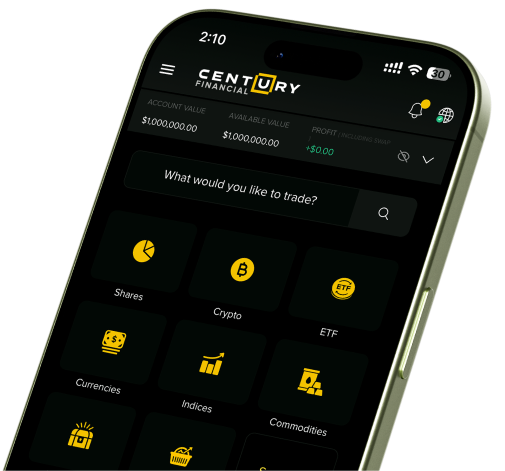
Century Financial carries shares and ETFs alongside CFDs on indices, currencies, and commodities within one account, through the Century Trader App and MT5. Regulated by the Financial Services Commission (FSC) in Mauritius, with more than 35 years and an education-first model behind it.
Two Questions, Not Two Tribes
Strip out the myths, and the distinction becomes usable. Investing asks whether an asset will be worth more because of what it does. Trading asks whether its price will move, and which way. Holding period, instrument choice, and cost structure all follow from that single question, which is why arguments about which approach is superior tend to go nowhere. They are answers to different problems.
Working out which question you are asking on any given position is the useful exercise, and it usually clarifies position size and exit rules at the same time. Century Financial offers both routes in one account, with a demo environment to test an approach before committing capital.
FAQs
The content in this blog, including any research, analysis, opinions, forecasts, or other information (collectively, "Information"), is provided by Century Financial Limited (the “Company”) for marketing, educational, and general informational purposes only. It should not be construed as investment advice, a recommendation, or a solicitation to buy or sell any financial instruments.
This Information may also be published across various channels, including Company’s website, third-party platforms, newsletters, marketing materials, emails, social media, messaging apps, webinars, and other communications. While the Company strives for accuracy, we do not guarantee the completeness, reliability, or timeliness of any content. Any decisions made based on this Information are at your own risk. The Company accepts no liability for any loss or damage arising from its use.
Trading in financial products involves significant risk and may not be suitable for all investors. Please ensure you fully understand the risks and seek independent professional advice if necessary.
The Company is licensed and regulated by the Financial Services Commission (FSC) of Mauritius as an Investment Dealer (Full Service – Excluding Underwriting) under License No. GB24203860.
Please refer to the full risk disclosure mentioned on our website.