MU | Century Financial Limited

Introduction
Margin and leverage let a trader control a position larger than the capital deposited. That is the appeal, and it is also the entire source of the risk. Leverage doesn't change the market's direction; it changes how little movement it takes to matter.
What Leverage Actually Changes
At 1:500, a two-tenths-of-one-percent move against the position removes the entire deposit. Markets routinely produce moves that size, often within a single hour. Leverage narrows the distance between a normal price move and a closed position. The arithmetic is unforgiving and worth seeing laid out.
| Leverage | Deposit for $10,000 Exposure | Adverse Move That Erases It |
|---|---|---|
| 1:1 | $10,000 | 100% |
| 1:10 | $1,000 | 10% |
| 1:30 | $333 | 3.3% |
| 1:100 | $100 | 1% |
| 1:500 | $20 | 0.2% |
Four Risks That Compound
Margin and leverage risks rarely arrive one at a time. They tend to reinforce each other.
- Amplified loss: losses are calculated on full exposure, not the deposit
- Forced closure: positions close automatically once margin runs out
- Accruing cost: financing charges accumulate nightly regardless of direction
- Execution gaps: fast markets can fill below the level intended
Regulatory analysis across EU jurisdictions found that between 74% and 89% of retail accounts typically lose money trading leveraged contracts. The figures show leverage use more than instrument choice.
Where Timing Acts Against Pakistani Traders
Most margin guidance assumes a trader who can watch a position and add funds quickly. Neither assumption holds evenly across time zones.
The Volatile Hours Fall Overnight
Pakistan runs on UTC+5, which puts the most active, news-driven part of the global trading day well into the local night. A position sized comfortably at noon can face conditions at 1:00 am that nobody was awake to see.
- New York opens around 6:30 pm to 7:30 pm PKT
- US inflation data releases near 5:30 pm to 6:30 pm PKT
- Federal Reserve decisions land close to midnight PKT
Funding Takes Days, Not Minutes
A margin call assumes funds can arrive before the close-out triggers. Cross-border transfers, bank cut-off times, weekends, and local holidays all sit between the notification and the money. The response window is often shorter than the transfer itself.
- Transfers clear in business days, not trading hours
- Local holidays can close banks for several days
- Weekend gaps appear before Monday banking opens
Sizing for the Gap, Not Just the Move
This is where the two problems combine into something practical. A margin buffer sized only for expected volatility assumes an instant top-up. A buffer sized for realistic response time assumes the opposite, and it is a larger number.
The gap between a margin call and the earliest possible funding response is measurable in advance. It depends on your bank, your transfer method, and the day of the week, none of which change during a drawdown. Working that figure out before opening leveraged positions costs nothing and changes what a reasonable position size looks like.
Seeing the Margin Level Before It Becomes a Problem
Century Financial is regulated by the Financial Services Commission (FSC) in Mauritius and brings more than 35 years of market experience, with multilingual support reachable when a margin question cannot wait for business hours.
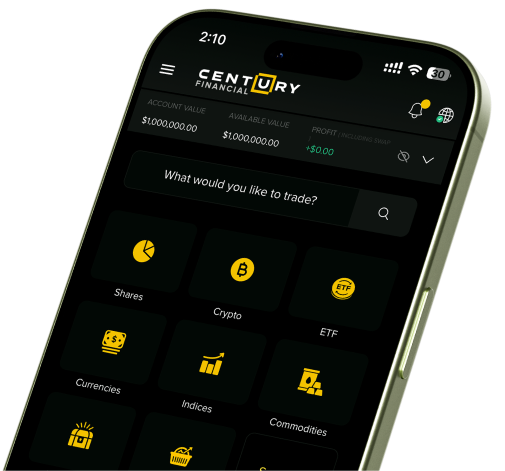
Margin risk is easier to manage when the numbers are visible, not buried. The Century Trader App displays live margin level and free margin against open positions, with mobile alerts, which matters when a position stays open through hours you are not at a screen. MT5 shows the same figures alongside charting tools so you can set exits in advance.
The Clock Is Part of the Position
Leverage is usually discussed as a question of “how much,” when it is really a question of “when.” The arithmetic determines how small a move can close a position, but the timing determines whether anyone is awake to respond and whether funds can arrive if they are. For a trader on Pakistan hours, both constraints tighten precisely when leveraged markets get busiest. Knowing the leverage ratio without knowing the response window is only half the calculation.
Anyone holding leveraged positions can work out their own version of this in an afternoon: the close-out level on the account, how long a transfer actually takes from their bank, and which hours their instruments tend to move. Century Financial's demo account, where you can trade in markets without committing real capital, is a good place to watch those hours play out before you commit capital.
FAQs
Disclaimer: CFDs are complex instruments and come with a high risk of losing money rapidly due to leverage. 74–89% of retail investor accounts lose money when trading CFDs. You should consider whether you understand how CFDs work and whether you can afford to take the high risk of losing your money. Past performance is not indicative of future results. This content is for informational purposes only and does not constitute investment advice or a recommendation to buy, sell, or hold any financial instrument. Century Financial does not guarantee the accuracy, completeness, or timeliness of this information and accepts no liability for any loss arising from its use.