MU | Century Financial Limited

Introduction
Coverage of AI tends to name the same handful of companies without explaining how they relate to one another. The AI supply chain has a clear structure: a small number of firms make the machines, a smaller number make the chips, and a larger group builds and sells what runs on them — knowing which company sits where makes almost everything else easier to follow.
Not Software, Mostly
The AI buildout is physical. It runs on data centers, semiconductors, cooling systems, and electricity supply, which is why so much of the spending shows up as capital expenditure rather than research budgets. To put one aspect — electricity demand — into numbers, the International Energy Agency (IEA) states that global data center electricity demand rose 17% in 2025, with power use from accelerated servers projected to grow by around 30% annually.
The Layers
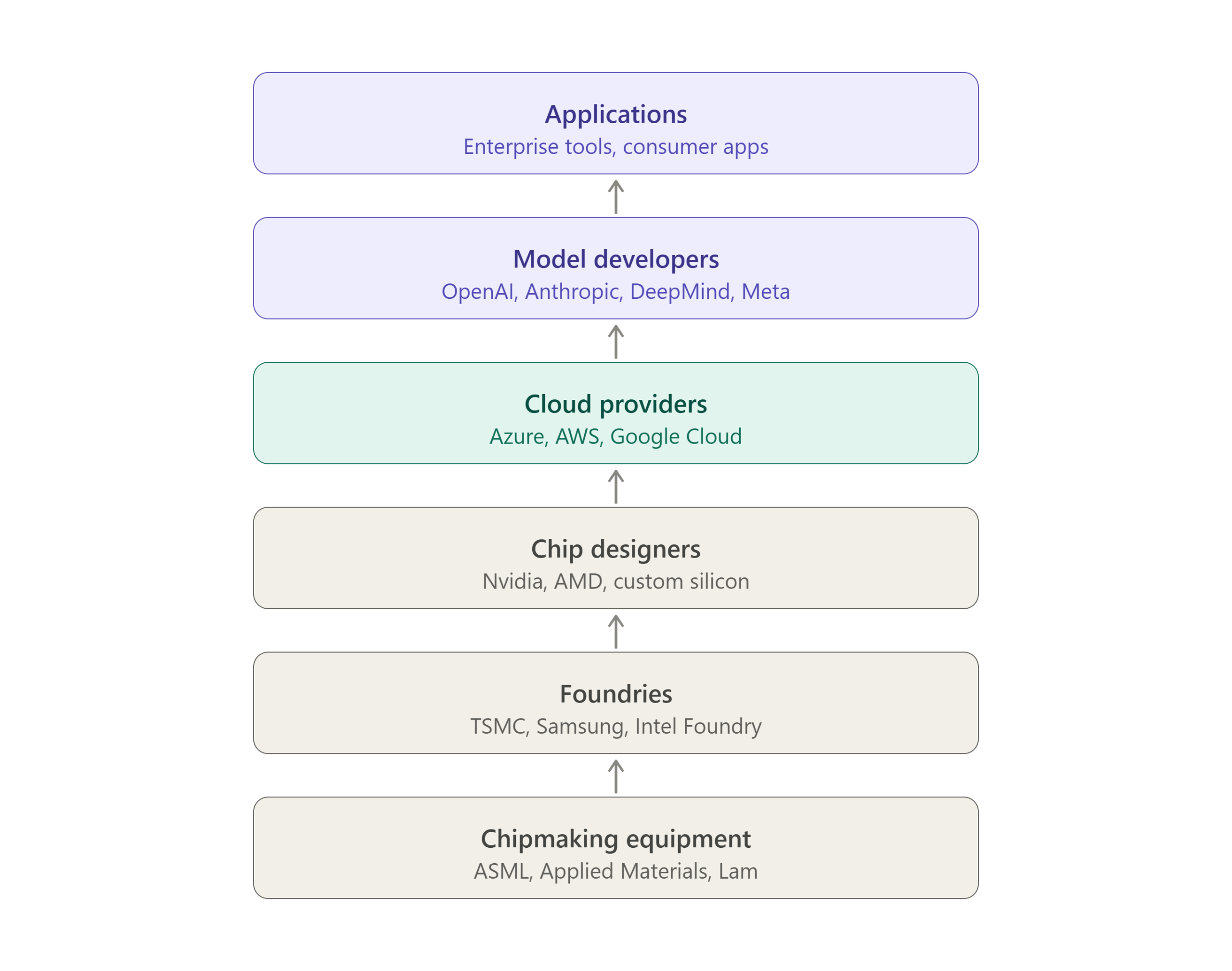
| Layer | What It Does | Company Examples |
|---|---|---|
| Chipmaking Equipment | Builds the machines that print chips | ASML, Applied Materials, Lam Research |
| Foundries | Manufactures chips to order | TSMC, Samsung, Intel Foundry |
| Chip Designers | Designs processors, does not fabricate | Nvidia, AMD, plus in-house silicon |
| Cloud Providers | Operates data centres, rents compute | Microsoft Azure, AWS, Google Cloud |
| Model Developers | Trains and licenses AI models | OpenAI, Anthropic, Google DeepMind, Meta |
| Applications | Sells software built on those models | Enterprise and consumer software firms |
Designers vs Manufacturers
A common misreading is that chip companies make chips. Most do not. Fabless designers such as Nvidia and AMD create architecture and outsource production to foundries. The design and manufacturing sit in different companies, on different continents.
In-House Silicon
Several cloud providers, including Google's TPU, Amazon's Trainium and Microsoft's Maia, now design their own accelerators alongside buying Nvidia's. According to TrendForce's predictions, custom chip shipments by cloud service providers are expected to grow by about 44.6% year-on-year in 2026, compared with 16.1% for merchant GPUs. This is why the same company can appear as both a customer and a competitor to Nvidia.
Where the Dependencies Sit
The layers are not evenly populated. Some have many participants, and others have almost none; that imbalance is another fact worth noting.
- ASML is the sole supplier of EUV lithography systems
- TSMC manufactures the leading-edge chips for most major designers
- Nvidia holds an estimated 70% to 88% of AI accelerator revenue
- Model developers are the most crowded layer, and the least capital-intensive to enter
Why the Same Names Recur
Companies in the AI supply chain frequently occupy more than one role. A cloud provider may host a model developer, invest in it, and design competing chips. A chip designer may sell to a customer it also holds a stake in. These overlaps are disclosed and legal, but they mean a single company can appear at several points in the chain, which is part of why coverage feels repetitive.
What This Means for Index Exposure
Since each layer depends on the one below it, a problem at the base does not stay there. If ASML cannot ship lithography machines, TSMC cannot produce leading-edge chips. If TSMC cannot produce them, Nvidia has nothing to sell. If Nvidia has nothing to sell, cloud providers cannot expand capacity, and the model developers renting that capacity are stuck — one bottleneck, four layers affected.
That chain reaches further than it might appear. Seven of the ten largest companies in the S&P 500 sit somewhere in the AI supply chain, and the top ten together account for roughly a third of the index by weight. Anyone holding a broad index fund, therefore, holds AI exposure, whether or not they ever intended to.
The "Bubble" Discourse
Knowing who does what explains the structure, but not the money moving through it. The commitments announced between these companies run into hundreds of billions of dollars, and those figures are quoted far more often than they are examined.
Some of that capital has changed hands, some is staged against milestones, and some has been revised since it was announced. That distinction is where the next piece in this series picks up.
Access Across the Chain
Regardless of your outlook, AI garners a lot of attention, capital, and revenue. Shifts in AI trends impact markets around the world; therefore, timely access to these companies becomes crucial.
Be it direct investments, hedging through CFDs, or committing capital to pre-IPO companies, Century Financial offers the platforms you need to execute your strategy. With Century Trader enabling on-the-go trading, you can be ready for every market break or bubble.
Knowing the Map
The AI supply chain is a stack, not a single industry. Some layers hold dozens of firms, and some hold one, but all are intricately intertwined. That structure explains most of the market behavior attributed to AI, including why a single earnings report can move indices worldwide.
Understanding the map is separate from acting on it, and markets rarely give much notice either way. Century Financial brings over 35 years of market experience and FSC Mauritius regulation to traders across the globe, with the Century Trader App placing shares, indices, commodities and more within reach from anywhere. If you are reviewing where your exposure sits across sectors and want to explore options the broader market has yet to take a stake in, open an account today.
FAQs
Disclaimer: CFDs are complex instruments and come with a high risk of losing money rapidly due to leverage. 74–89% of retail investor accounts lose money when trading CFDs. You should consider whether you understand how CFDs work and whether you can afford to take the high risk of losing your money. Past performance is not indicative of future results. This content is for informational purposes only and does not constitute investment advice or a recommendation to buy, sell, or hold any financial instrument. Century Financial does not guarantee the accuracy, completeness, or timeliness of this information and accepts no liability for any loss arising from its use.