MU | Century Financial Limited

Introduction
CFD trading is one of the most widely used approaches to accessing global financial markets, yet it's also one of the most misunderstood. A CFD, or Contract for Difference, is an agreement between a broker and a trader to exchange the difference in the price of an asset between when a trade is opened and when it is closed. You never own the underlying asset. What you're trading is the price movement itself.
That distinction matters because it's what makes CFDs flexible enough to be used across dozens of asset classes, in rising and falling markets, with adjustable position sizes. It's also what makes them worth understanding properly before committing real capital.
The Basic Mechanics of a CFD
Buying and Selling Without Owning the Asset
When you trade a CFD, you're entering a contract with your broker. If you believe the price of an asset will rise, you open a buy position. If you believe it will fall, you open a sell position. At no point do you take ownership of shares, barrels of oil, or units of currency.
Structurally different from buying stocks on an exchange, a stock purchase gives you ownership and, in many cases, voting rights and dividends. A CFD gives you price exposure only and is fit for traders focused purely on market movements more than ownership.
How CFD Profits and Losses Are Calculated
Your profit or loss on a CFD is determined by the difference between your entry price and your exit price, multiplied by the number of units in your position.
If you open a buy CFD on a stock at $100 and close it at $115, your gain is $15 per unit held. If the price drops to $88 instead, your loss is $12 per unit. The direction of the move and the size of your position determine the outcome. Leverage, which we will get into in detail, scales both figures significantly.
Going Long vs. Going Short
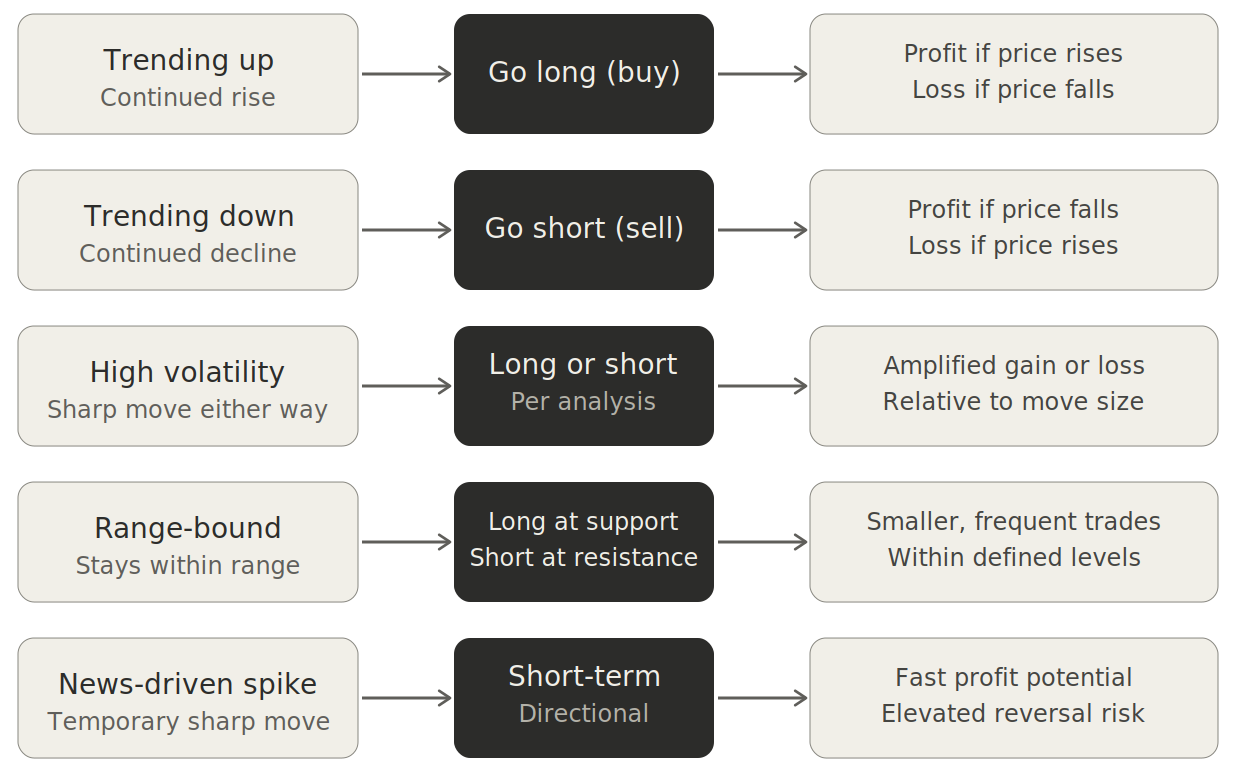
Going long means opening a buy position in anticipation of the price rising. Going short means opening a sell position in anticipation of the price falling. CFDs make both equally straightforward to execute, which is a meaningful advantage over traditional investing, where profiting from a price decline requires more complex instruments.
Short selling through CFDs is commonly used to hedge existing positions or to trade falling markets directly. It carries the same risk profile as going long, because the market can move against you in either direction.
What Can You Trade as a CFD?
CFDs are available across a broad range of global markets, making them one of the most versatile instruments available to retail traders. The underlying asset class determines the price drivers and volatility profile you'll be working with.
- Shares: Price exposure to individual company stocks without requiring share ownership
- Indices: Trade the performance of entire markets such as the S&P 500, FTSE 100, or Nikkei 225
- Commodities: Access to oil, gold, silver, natural gas, and agricultural products
- Currencies (Forex): Trade major, minor, and exotic currency pairs
- ETFs: Gain exposure to diversified baskets of assets, sectors, or themes
- Treasuries: Trade government bonds and interest rate products
- Cryptocurrencies: Price exposure to digital assets without the need for a separate wallet
Understanding Leverage in CFD Trading
Important Terms and Concepts in CFD Trading
Before working through how leverage functions, a few terms are worth defining clearly.
Leverage is the mechanism that allows you to control a larger position than your deposited capital would otherwise permit. The deposit required to open and maintain a leveraged position is called Margin. Spread is the difference between the buying and selling price quoted by the broker, and overnight financing (also called a swap) is a charge applied when a leveraged position is held past the daily close.
How Leverage Works in Practice
Suppose a broker offers 100:1 leverage on a stock CFD. To open a position worth $10,000, you only need to deposit $100. Your exposure to price movement is based on the full $10,000, not just the $100 you put in.
A 5% move in favor of the full position produces a $500 gain, a 500% return on your $100 margin. The same 5% move against you produces a $500 loss. Leverage scales your exposure to market movements, whether for or against your position.
Margin Requirements Explained
Margin requirements are stated as a percentage of the total position value. For example, a 5% margin requirement necessitates $500 to open a $10,000 position. If the market moves unfavorably and the account balance drops below the broker's minimum margin threshold, a margin call may be issued, requiring additional funds or resulting in a reduced or closed position.
Different asset classes carry different margin requirements. Volatile securities normally require a higher margin to reflect the increased risk.
Why Leverage Amplifies Both Gains and Losses
This point is worth stating plainly: leverage does not favor the trader by default. It scales exposure in both directions equally. A position that doubles your potential gain also doubles your potential loss relative to the margin deposited.
Experienced traders use leverage selectively and in combination with defined risk management parameters. Using maximum available leverage on every trade is one of the fastest ways to deplete a trading account.
CFDs vs. Traditional Trading
| Factor | Traditional Trading | CFD Trading |
|---|---|---|
| Asset Ownership | Full ownership of shares or assets | No ownership of underlying asset |
| Short Selling | Requires borrowing shares or complex instruments | Straightforward via sell position |
| Leverage | Limited or unavailable for most retail investors | Available across most asset classes |
| Capital Required | Full purchase price required upfront | Lower, margin-based entry |
| Overnight Costs | No overnight financing for share ownership | Financing charges apply on open positions |
| Dividend Exposure | Direct dividend payments to shareholders | Adjustments applied, not direct dividends |
| Market Access | Typically limited to exchanges the broker supports | Global markets across multiple asset classes |
| Regulatory Framework | Governed by exchange and securities regulation | Varies by broker and jurisdiction |
Risk Management When Trading CFDs
Stop-Loss and Take-Profit Orders
A stop-loss order automatically closes your position if the price reaches a defined level against you, capping your loss at a predetermined amount. A take-profit order closes the position when price reaches your target, locking in a gain without involving manual action.
Both tools are standard on platforms including MT5 and the Century Trader App. Using them consistently is one of the clearest markers that separates disciplined traders from reactive ones.
Position Sizing and Exposure
Position sizing involves determining the number of units to trade based on account size and acceptable risk per trade. Most experienced traders risk a defined percentage of their account on any single position, typically between 1% and 3%.
Overleveraging and oversizing positions are among the most common structural mistakes in CFD trading. Managing exposure across multiple open positions is as important as managing any individual trade.
The Role of Volatility
Volatility describes the speed and magnitude of price movement in a market. High-volatility conditions can produce fast gains, but they also increase the likelihood of stop-losses being triggered and positions moving sharply against you.
Understanding the typical volatility profile of the asset you're trading, and adjusting position size and stop placement accordingly, is part of managing CFD risk efficiently.
Market Mechanisms of CFD Trading
Understanding when to go long or short is central to the CFD trading strategy. This diagram outlines the basic decision framework:
Advantages and Disadvantages of CFD Trading
| Advantages | Disadvantages |
|---|---|
| Access to global markets from one account | Leverage amplifies losses as well as gains |
| Trade rising and falling markets with equal ease | Overnight financing costs reduce returns on held positions |
| Lower capital requirement through margin | Spread costs apply on every trade |
| Broad asset class coverage in a single platform | No ownership rights — dividends are adjustments, not payments |
| Flexible position sizing | Requires active risk management to trade sustainably |
| No stamp duty on share CFDs in most jurisdictions | Not suitable for all traders or investment goals |
Who Is CFD Trading Suited For?
CFD trading suits traders who want flexible access to global markets, the ability to profit in both directions, and control over position sizing without the capital requirements of direct ownership. It's not a passive investment vehicle.
- Active traders monitoring markets regularly
- Investors looking to hedge existing investment portfolios
- Those seeking exposure to multiple asset classes from one account
- Traders comfortable with leverage and its associated risks
- Traders wanting short-term exposure without long-term ownership
Access Global CFD Markets in One Place
Century Financial provides access to CFD trading across shares, indices, commodities, currencies, ETFs, treasuries, and more, all from a single account. The Century Trader App offers a clean, mobile-first trading experience, while MT5 delivers the depth and customization that active traders rely on.
Regulated by the Financial Services Commission (FSC) of Mauritius, Century Financial has served traders across global markets for over 35 years. The focus has always been on building complex markets that are accessible without stripping away the tools serious traders need. Whether you're exploring CFDs for the first time or expanding your existing strategy, the infrastructure is in place to support it.
Understanding CFD Trading
CFD trading provides genuine flexibility, including global market access, the ability to trade in both directions, and leverage that enables meaningful exposure with a smaller upfront margin. These same characteristics reward preparation and penalize carelessness.
Effective use of CFDs is not limited to the most experienced traders, but to those who understand their approach and rationale before entering a trade. Whether testing strategies with a demo account or making informed decisions with the right financial tools, Century Financial provides the infrastructure for smooth participation in global markets.