
Forex 2025: Central Banks,
Inflation, and Geopolitical Drivers
Introduction:
The foreign exchange (forex) market in 2025 is evolving rapidly. From rate pivots by major central banks to mounting geopolitical uncertainty, traders are facing a dynamic environment. Understanding the macro forces at play isn’t just helpful—it’s essential for navigating this volatile year. In this article, we break down the biggest drivers of forex in 2025, focusing on central bank policy, inflation dynamics, and political instability
Key Forex Movers in 2025
In Q2 2025 alone, currency markets have seen sharp moves:
- USD/JPYsurged past 155 for the first time since 1990, following diverging rate paths between the Fed and BoJ.
- EUR/USDslipped below 1.06 amid weaker Eurozone PMI data
- Emerging market currencies have shown mixed trends, with commodity-linked currencies gaining on rising oil prices.
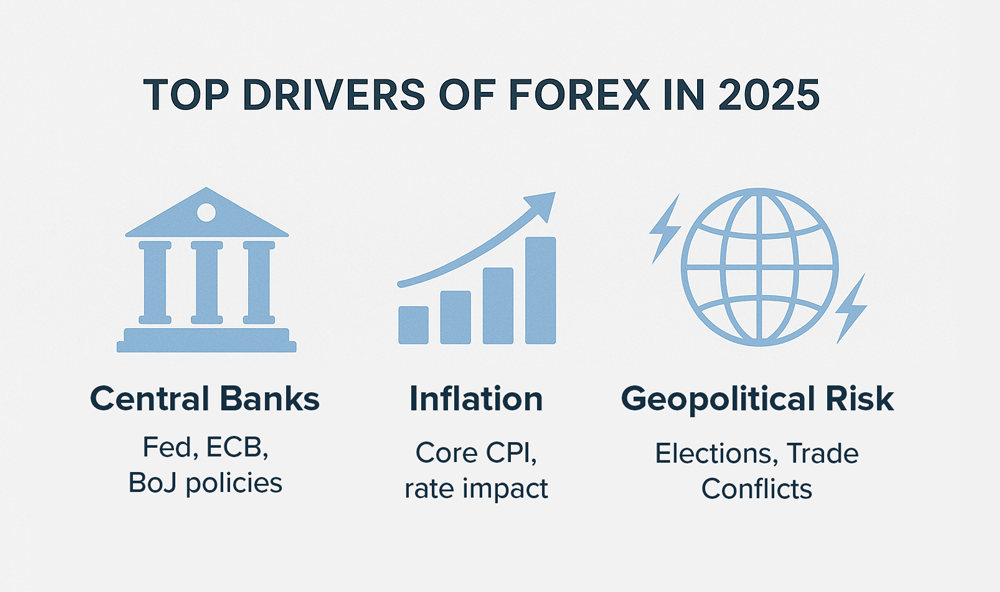
These shifts are not random – they’re rooted in three core macro forces shaping forex this year.
Central Banks Take Center Stage
The actions of the Federal Reserve, European Central Bank (ECB), and Bank of Japan (BoJ) remain the single most influential force in forex.
- The Fed has held rates steady at 5.25% but has pushed back on rate cuts due to sticky services inflation.
- Meanwhile, the ECB has started trimming rates, with one cut in March and more expected in H2 2025 as the bloc struggles with recessionary signals.
- The BoJ ended its negative rate policy in Q1 but remains dovish overall.
Key Impact: This divergence is widening interest rate differentials, creating carry trade opportunities and driving volatility in major pairs like USD/EUR and USD/JPY
Inflation Still in Focus
Inflation has not gone away in 2025. While headline CPI has come down in many developed economies, core inflation —especially in the U.S.—remains above 3%, keeping central banks cautious.
- U.S. Core PCE (as of May 2025): 3.2% YoY
- Eurozone Core Inflation: 2.1% YoY, trending downward
- UK CPI: Remains stubbornly high at 4.0%, forcing the BoE to hold rates
This is directly impacting forex sentiment, particularly when inflation surprises to the upside, as seen with the April CPI reading in the U.S., which triggered a USD rally.
Geopolitical Risk Adds Fuel
Beyond economics, geopolitics is an undercurrent that can’t be ignored:
- Middle East tensions have lifted oil prices above $90/barrel, boosting currencies like the CAD and NOK .
- China–U.S. trade friction has escalated again, with tit-for-tat tariff announcements driving risk-off flows into the dollar and yen.
- The presidential election cycle U.S. is adding uncertainty, with forex traders watching for policy shifts that may affect trade and defense.
Key takeaway: In times of uncertainty, safe-haven currencies such as the USD, CHF, and JPY typically gain, while risk-sensitive currencies like the AUD and ZAR may weaken
Trading Tips for 2025
Given the macro backdrop, here are a few actionable strategies for forex traders:
- Watch central bank speeches: Timing entries around Fed and ECB policy announcements can be profitable.
- Use a multi-timeframe approach to manage volatility and avoid being whipsawed during high-impact events
- Hedge exposure to geopolitical risk with safe-haven currencies or commodities like gold.
- Consider macro pairings like USD/JPY or EUR/CHF where interest rate divergence is playing out in real-time.
Conclusion
2025 is proving to be a defining year for the forex market. The combined impact of central bank policies, persistent inflation, and geopolitical instability is reshaping currency trends. For traders, staying updated on these macro forces is not just an edge—it’s a necessity.
If you’re navigating forex markets this year, keep your eyes on the fundamentals. Because in 2025, they’re calling the shots